

Research progress of ant venom system
-
摘要:
蚂蚁隶属于膜翅目细腰亚目,是种类和数量极为丰富的社会性昆虫。蚂蚁具有特化的毒液器官可分泌毒液,用于防御、捕食及社会交流等。其毒液组成复杂,富含多肽和蛋白,以及挥发性或非挥发性的化合物,具有溶细胞、溶血、致敏、杀虫和抗菌等生物活性。随着物种的演化,蚂蚁毒液系统分化为有螫针和无螫针两种类型。不同的螫针类型表明蚂蚁毒液的组成、功能,及生态适应性可能有所不同。因此,蚂蚁的毒液系统是研究适应性演化的良好模型,同时也是生物活性分子的重要资源库。本文综述了蚂蚁毒液系统的形态结构,毒液成分,功能和演化的研究进展,为深入理解蚂蚁毒液系统的多样性,发掘具有潜在应用价值的新型生物医药和农药提供参考。
Abstract:Ants represent one of the most diverse and abundant eusocial insects. Ants possess specific venom apparatuses that secrete venom for defense, predation, and social communication. The venom is a complex mixture containing a rich array of peptides and proteins, as well as volatile or non-volatile compounds. These venom components exhibit various biological activities, including cell lysis, hemolysis, sensitization, insecticidal effects, and antimicrobial properties. With the evolution of ant species, their venom systems have diverged into two structural morphotypes: stinging and stingless. The variations in venom apparatus may impact the composition, function, and ecological adaptation of venom. Consequently, the venom system of ants serves as an excellent model for investigating adaptive evolution and constitutes a significant repository of bioactive chemicals. This review summarizes current knowledge of ant venom systems, encompassing their morphological architecture, biochemical composition, functional diversity, and evolution. It aims to deepen the understanding of the diversity of ant venom systems, serving as a reference for the exploration of novel bioactive compounds in biomedicine and agrochemical development.
-
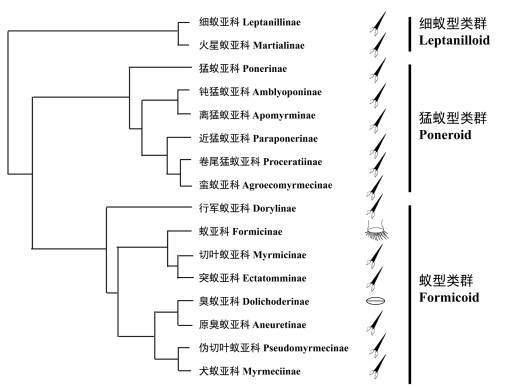
蚁科(Formicidae)起源于1.15亿年至1.35亿年前,由类似胡蜂的祖先进化而来(Brady et al.,2006;Borowiec et al.,2020),现存已知物种14 000余种,分别属于16个亚科(http://www.antcat.org/)。据统计,全球蚂蚁的个体数量近20 × 1015,为陆地动物生物量的15%~20%,在陆地生态系统中占重要地位(Schultheiss et al.,2022)。基于全基因组数据的系统发育分析,蚂蚁的16个亚科可划分为3个类群(图 1),即蚁型类群(Formicoid)、猛蚁型类群(Poneroid)以及细蚁型类群(Leptanilloid)(Branstetter et al.,2017;Borowiec et al.,2025;Vizueta et al.,2025)。蚁型类群的物种最为丰富,包含8个亚科,约有12 000个种,约占蚂蚁种类的90%。其次是猛蚁型类群,占蚂蚁种类的8%~9%,分布于6个亚科(Vizueta et al.,2025)。细蚁型类群数量最少,仅占蚂蚁种类的1%,由一种新热带种尤里卡火星蚁Martialis heureka和细长蚁亚科Leptanillinae物种构成。
 下载:
全尺寸图片
下载:
全尺寸图片
蚂蚁具有高度特化的毒液系统,并在演化历程中分化为有螫针和无螫针两种类型。不同螫针类型的分化,表明其毒液的组成、功能,及生态适应性可能有所不同,使蚂蚁毒液系统成为适应性演化研究的理想模型(Schendel et al.,2019)。蚂蚁毒液具有高度的异质性,不同物种的毒液成分和生物活性差异较大,极大的丰富了动物天然毒液库的组成和功能多样性(Touchard et al.,2024b)。研究表明,蚂蚁毒液中含有多种生物活性分子,包括盐类、甲酸、生物胺、生物碱、游离氨基酸、碳氢化合物、多肽和蛋白质等,在防御、捕食、抗菌及社会交流等活动中发挥重要功能(Fox et al.,2010;Touchard et al.,2016;Schendel et al.,2019)。因此,蚂蚁毒液还是巨大的生物资源宝库,具有潜在的药理价值。本文主要综述蚂蚁毒液系统的形态特征,及毒液中蛋白质类和非蛋白质类生物活性分子的研究进展,旨在为深入理解蚂蚁毒液系统的多样性提供参考。
1. 蚂蚁毒液系统的形态结构
蚂蚁的毒液系统由毒液器官、毒液及毒液排泄器官组成(Fry et al.,2009a;Schendel et al.,2019)。毒液通过毒液排泄器官进行输送,蚂蚁的毒液排泄器官演化为有螫针和无螫针两种类型(图 1)。蚂蚁的螫针起源于产卵器,位于腹部末端,约71%的蚂蚁具有螫针(Fox et al.,2010)。部分蚂蚁的螫针在演化过程中失去了蜇刺的能力,如行军蚁亚科中行军蚁属Dorylus的螫针演化为不起蜇刺作用的短刺,其毒腺分泌物是踪迹信息素的来源。而蚁亚科和臭蚁亚科的蚂蚁则演化为完全无螫针的物种。蚁亚科蚂蚁通过腹部末端圆形的“泌酸孔”孔喷洒毒液,这也是蚁亚科物种特有的结构;臭蚁亚科蚂蚁的腹部末端则演化为一横裂缝状结构(Touchard et al.,2016;Zhou et al.,2018)。蚁亚科泌酸孔的外部具有刚毛,可能用于分散毒液喷雾,并防止毒液在释放时洒到蚂蚁的腹部。有的蚁亚科物种喷射距离可达几厘米远,如Formica s. str.喷射毒液的距离为50~80 cm(Koch et al.,2025)。
蚂蚁的毒液器官由毒腺和毒囊组成,并附着有杜氏腺(副腺),是合成和储存毒液的场所(图 2)(Schoeters and Billen,1998)。毒腺具有两根游离的毒腺细丝,这两根细丝在靠近毒囊的位置融合在一起,在有的物种中形成了卷曲腺(Billen and Al-Khalifa,2018)。依据卷曲腺的有无以及着生位置可将蚂蚁的毒液器官分为3种类型:“无卷曲腺”型,存在于钝猛蚁亚科和细蚁亚科物种;“垫状(Pulvinate)”型,为蚁亚科蚂蚁特有,其卷曲腺呈垫状覆盖于毒囊外部;“定心带(Bourreleted)”型,存在于余下的亚科,其卷曲腺位于毒囊内部(Schoeters and Billen,1998;Schoeters et al.,1999;Zhou et al.,2018)。超微结构研究表明,毒腺细丝的横切面由外到内,分别为基膜层、分泌细胞层和导管细胞层,内膜以及中央内腔(Billen and Al-Khalifa,2018)。毒腺细丝中含有大量的分泌细胞,这些细胞内存在大量的线粒体和发达的端器,表明了毒腺的分泌能力。分泌细胞排列在中央管腔周围,通过端器与导管细胞相连。作为毒腺细丝的延伸,卷曲腺也由大量分泌细胞组成,具有发达的端器和导管。这些导管沿着卷曲腺弯曲的腔体向外开放。毒囊则主要负责毒液的储存,由肌肉层包围,内表面为折叠状结构,具有由多边形细胞组成的薄壁组织(Billen and Al-Khalifa,2018;Zhou et al.,2018)。
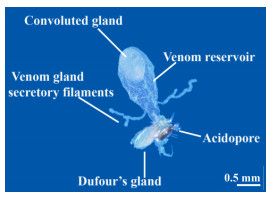 图 2 罗思尼刺结蚁Lepisiota rothneyi毒液器官的形态结构注:Venom gland secretory filaments,毒腺细丝;Convoluted gland,卷曲腺;Venom reservoir,毒囊;Dufour's gland,杜氏腺;Acidopore,泌酸孔。Fig. 2 Morphological structure of the ant venom apparatus of Lepisiota rothneyi下载:
全尺寸图片
图 2 罗思尼刺结蚁Lepisiota rothneyi毒液器官的形态结构注:Venom gland secretory filaments,毒腺细丝;Convoluted gland,卷曲腺;Venom reservoir,毒囊;Dufour's gland,杜氏腺;Acidopore,泌酸孔。Fig. 2 Morphological structure of the ant venom apparatus of Lepisiota rothneyi下载:
全尺寸图片
毒液系统的形态结构是影响毒液成分多样性的重要因素(Fry et al.,2009b)。无螫针的蚁亚科蚂蚁毒液中普遍含有甲酸,其含量可达毒液含量的70%,是一种重要的警报信息素,可用于对抗竞争对手和捕食者(Zhang et al.,2015)。臭蚁亚科的毒液中则含有酮和环烯醚萜苷等化合物(Shi et al.,2017)。相比之下,有螫针的蚂蚁毒液中除低分子量化合物外,通常含有更为丰富的多肽和蛋白质(Aili et al.,2014;Touchard et al.,2016)。因此,蚂蚁毒液器官的形态结构差异为毒液系统的演化提供了重要线索。
2. 蚂蚁毒液的生物活性成分
蚂蚁的毒液器官微小且毒液分泌量低,导致样本采集困难,限制了蚂蚁毒液的研究。而多组学技术的发展极大的促进了蚂蚁毒液的研究,经统计,目前有40余种蚂蚁的毒液蛋白成分通过组学技术得以解析(Mouchbahani-Constance and Sharif-Naeini,2021),具体见表 1。
表 1 已利用组学技术鉴定毒液蛋白成分的蚂蚁物种Table 1 Venom components identified based on omics technologies亚科
Subfamily物种
Species毒液成分分析技术
Venom component analysis technology参考文献
References突蚁亚科
Ectatomminae金属皱猛蚁Rhytidoponera metallica 转录组Transcriptome + 蛋白组Proteome Robinson et al.,2023b 褐色外刺猛蚁Ectatomma brunneum 蛋白组Proteome Aili et al.,2016 瘤外刺猛蚁Ectatomma tuberculatum 蛋白组Proteome Silva et al.,2018 四齿刺猛蚁Ectatomma quadridens 蛋白组Proteome Pluzhnikov et al.,2014 瘤外刺猛蚁Ectatomma opaciventre 蛋白组Proteome Correia et al.,2022 褐色外刺猛蚁Ectatomma brunneum 蛋白组Proteome Bernardi et al.,2024 蚁亚科
Formicinae黄毛蚁Lasius flavus 转录组Transcriptome Wang et al.,2023 犬蚁亚科
Myrmeciinae贪食犬蚁Myrmecia gulosa 转录组Transcriptome + 蛋白组Proteome Robinson et al.,2018 多毛犬蚁Myrmecia pilosula 蛋白组Proteome Wiese et al.,2007 切叶蚁亚科
Myrmicinae武装毒针蚁Daceton armigerum 转录组Transcriptome + 蛋白组Proteome Barassé et al.,2022 红狂蚁Manica rubida 转录组Transcriptome + 蛋白组Proteome Touchard et al.,2020 小红蚁Myrmica rubra 转录组Transcriptome + 蛋白组Proteome Hurka et al.,2022 皱结红蚁Myrmica ruginodis 转录组Transcriptome + 蛋白组Proteome Barassé et al.,2022;
Hurka et al.,2022加州须蚁Pogonomyrmex californicus 转录组Transcriptome + 蛋白组Proteome Barassé et al.,2022 红火蚁Solenopsis invicta 转录组Transcriptome + 蛋白组Proteome Cai et al.,2022 残暴火蚁Solenopsis saevissima 转录组Transcriptome + 蛋白组Proteome Barassé et al.,2022 柔弱窄结蚁Stenamma debile 转录组Transcriptome + 蛋白组Proteome Barassé et al.,2022 非洲铺道蚁Tetramorium africanum 转录组Transcriptome + 蛋白组Proteome Barassé et al.,2022 双隆骨铺道蚁
Tetramorium bicarinatum基因组Genome + 转录组Transcriptome + 蛋白组Proteome Touchard et al.,2018;
Touchard et al.,2024a毒针蚁属Daceton armigerum 转录组Transcriptome + 蛋白组Proteome Touchard et al.,2024b 近猛蚁亚科
Paraponerinae棒结近猛蚁Paraponera clavata 转录组Transcriptome + 蛋白组Proteome Aili et al.,2020 猛蚁亚科
Ponerinae山大齿猛蚁Odontomachus monticola 转录组Transcriptome + 蛋白组Proteome Kazuma et al.,2017;
Tani et al.,2019血色大齿猛蚁
Odontomachus haematodus转录组Transcriptome + 蛋白组Proteome Touchard et al.,2024b 大齿猛蚁属Odontomachus mayi 转录组Transcriptome + 蛋白组Proteome Touchard et al.,2024b 大齿猛蚁属Odontomachus scalptus 转录组Transcriptome + 蛋白组Proteome Touchard et al.,2024b 大齿猛蚁属Odontomachus hastatus 转录组Transcriptome + 蛋白组Proteome Touchard et al.,2024b 方头恐猛蚁Dinoponera quadriceps 转录组Transcriptome + 蛋白组Proteome Ceolin Mariano et al.,2019 缺缘钩猛蚁Anochetus emarginatus 蛋白组Proteome Touchard et al.,2016;
Touchard et al.,2024b猛蚁亚科
Ponerinae南方恐猛蚁Dinoponera australis 蛋白组Proteome Johnson et al.,2010 尖顶新猛蚁Neoponera apicalis 转录组Transcriptome + 蛋白组Proteome Aili et al.,2016;
Touchard et al.,2024b变形新猛蚁Neoponera commutata 转录组Transcriptome + 蛋白组Proteome Aili et al.,2016;
Touchard et al.,2024b哥氏新猛蚁Neoponera goeldii 转录组Transcriptome + 蛋白组Proteome Orivel et al.,2001;
Touchard et al.,2024b全异新猛蚁Neoponera villosa 蛋白组Proteome Cologna et al.,2018 新猛蚁属Neoponera inversa 转录组Transcriptome + 蛋白组Proteome Touchard et al.,2024b 矛形大齿猛蚁Odontomachus hastatus 蛋白组Proteome Aili et al.,2016 条纹厚结猛蚁Pachycondyla striata 蛋白组Proteome Santos et al.,2017 裂爪大齿猛蚁Odontomachus chelifer 转录组Transcriptome Guimarães et al.,2023 伪切叶蚁亚科
Pseudomyrmecinae埃塞细长蚁Tetraponera aethiops 转录组Transcriptome + 蛋白组Proteome Barassé et al.,2019;Barassé et al.,2022 螱巢伪切叶蚁
Pseudomyrmex termitarius转录组Transcriptome + 蛋白组Proteome Touchard et al.,2014b;Touchard et al.,2024b 潜入伪切叶蚁
Pseudomyrmex penetrator转录组Transcriptome + 蛋白组Proteome Touchard et al.,2014;Touchard et al.,2024b 纤细伪切叶蚁Pseudomyrmex gracilis 转录组Transcriptome + 蛋白组Proteome Touchard et al.,2014;Touchard et al.,2024b 三重伪切叶蚁
Pseudomyrmex triplarinus蛋白组Proteome Pan and Hink,2000 伪切叶蚁Pseudomyrmex viduus 转录组Transcriptome + 蛋白组Proteome Touchard et al.,2024b 2.1 蚂蚁毒液肽类毒素
研究表明,蚂蚁中毒液含有丰富的肽类,加州须蚁Pogonomyrmex californicus毒液中肽类成分占93.7%,非洲铺道蚁Tetramorium africanum毒液肽类成分占79%(Saidemberg et al.,2011;Barassé et al.,2022)。蚂蚁的毒液肽根据生物学功能主要分为溶细胞肽和神经毒素两大类(Dos Santos-Pinto et al.,2018)。这些肽也可根据序列结构可划分为线性肽、二聚体肽和富含二硫键的多肽(Aili et al.,2014)。
2.1.1 线性肽
蚂蚁毒液中含有丰富的肽类,且大多为分子量低于5 kDa(约35个氨基酸残基)的阳离子线性肽。此类肽通常具有两亲性结构,能够通过破坏细胞膜完整性发挥膜溶解作用。由于对膜溶解的非选择性活性,这类肽可有效靶向细菌细胞膜,常具有广谱抗菌活性,有助于蚂蚁对蚁群进行无菌处理(Orivel et al.,2001)。此外,溶细胞肽还具有杀虫和溶血等多种功能(Heep et al.,2019)。溶细胞肽还可通过破坏细胞膜,促进其他神经毒素扩散到分子靶标,从而对猎物产生毒性(Bernheimer and Rudy,1986;Kuhn-Nentwig,2003;Touchard et al.,2016)。目前,已在多种有螫针蚂蚁的毒液中鉴定出溶细胞肽,如猛蚁亚科中的ponericin和dinoponeratoxin(Orivel et al.,2001;Lima et al.,2018),犬蚁亚科的pilosulin(Wanandy et al.,2015),以及切叶蚁亚科的bicarinalin(Rifflet et al.,2012)。
猛蚁亚科中最具代表性的是新猛蚁属哥氏新猛蚁的毒液肽ponericin,这类肽在细胞膜等极性环境中为两亲性α-螺旋结构。研究表明,ponericin对革兰氏阳性和阴性细菌均有抗菌活性,同时还具有杀虫作用(Orivel et al.,2001)。在另外两种新猛蚁属蚂蚁,尖顶新猛蚁和全异新猛蚁毒液中也发现类似ponericin的肽类,推测其可能具有抗菌和杀虫活性。在恐猛蚁属中,南方恐猛蚁和方头恐猛蚁毒液中的dinoponeratoxin也是线性肽,其序列与ponericin同源。南方恐猛蚁毒液中的M-PONTX-Dq3a(Dq-1839)对金黄色葡萄球菌Staphylococcus aureus具有很强的抑制作用,能在较低的微摩尔浓度条件下阻止生物被膜的形成(Rocha et al.,2021)。此外,突蚁亚科的四齿刺猛蚁毒液中也鉴定到与ponericin同源的肽,其中3种肽(Q42、Q49和Q50)具显著抗菌活性,对革兰氏阴性和阳性菌均表现出较高的活性(Pluzhnikov et al.,2014)。
切叶蚁亚科中,最具代表性的是双隆骨铺道蚁毒液中的肽类bicarinalin,其序列同样具有典型的两亲性α-螺旋结构,并表现出较强的抗菌活性(Rifflet et al.,2012)。研究表明,bicarinalin还具有抗幽门螺杆菌Helicobacter pylori的特性,与用于治疗幽门螺杆菌的四种抗生素的活性相似,因此bicarinalin可用于开发新药(Guzman et al.,2017)。不仅如此,双隆骨铺道蚁毒液中还存在与pilosulins 1,3,5同源的多肽(Bouzid et al.,2013)。而pilosulin是犬蚁亚科多毛犬蚁毒液中一类重要的多肽,具有溶血、溶细胞和抗菌活性(Wanandy et al.,2015)。其中,pilosulin 1是由56个氨基酸残基组成的长线性肽,具有两亲性的α-螺旋,可与细胞膜结合,从而裂解微生物细胞膜,对革兰氏阳性和阴性菌具有广谱的抗菌活性(Wu et al.,1998;Zelezetsky et al.,2005)。研究表明,猛蚁亚科的南方恐猛蚁毒液中也含有α-螺旋结构的pilosulin-like肽,其中合成的pilosulin-like肽(Dq‐2562、Dq‐1503和Dq‐1319)对念珠菌Candida具有抑菌活性。基于转录和肽组学数据,于猛蚁亚科山大齿猛毒液中也鉴定到9个pilosulin样肽,pilosulin-like 1-8与pilosulin一样具有α-螺旋结构(Kazuma et al.,2017)。对其中6种合成肽的功能验证显示,pilosulin 1-4和6表现出抗菌和组胺释放活性。而pilosulin 4还是一种抗真菌肽,对酿酒酵母Saccharomyces cerevisiae具有较强的抑菌活性(Tani et al.,2019)。
近猛蚁亚科棒结近猛蚁毒液中的paraponeritoxin是蚂蚁中最早被鉴定的神经毒肽之一(Piek et al.,1991)。该肽由25个氨基酸残基组成,呈线性结构,由两个α螺旋通过β转角形成V形构象,能够调节脊椎动物和无脊椎动物的NaV电压门控钠通道,诱导长时间的高动作电位和重复放电,阻断昆虫中枢神经系统的突触传递(Szolajska et al.,2004)。由于其高效性,paraponeritoxin已被用于开发新型的生物杀虫剂(Johnson et al.,2017)。近年来,在切叶蚁亚科的红狂蚁和非洲铺道蚁,及突蚁亚科的金属皱猛蚁毒液中,陆续发现了与paraponeritoxin一级结构相似的多肽(U3-MYTX-Mri1a、Ta3a和Rm4a)。这些肽具有调节NaV电压门控钠通道的活性,可降低其激活的电压阈值,抑制通道失活(Robinson et al.,2023a)。而NaV通道是动物神经和肌肉功能不可或缺的组成部分,因此蚂蚁毒液中的NaV通道毒素可能对脊椎动物起到选择性防御作用(Robinson et al.,2023a)。
2.1.2 二聚体肽
除线性肽外,蚂蚁毒液中还存在二聚体肽,即两个亚基通过一个或几个二硫键相连组成的高度稳定的肽。二聚体肽具有多种三维结构,常以离子通道为靶点,可导致节肢动物瘫痪,是神经毒素中重要的研究对象(Touchard et al.,2020;Barassé et al.,2022)。蚂蚁毒液中的神经毒肽通常具有选择性、特异性和有效性,主要作用于离子通道,有助于捕食者快速固定猎物(Piek,1991)。
突猛蚁亚科瘤外刺猛蚁的毒液二聚体肽ectatomin(ET-1),是由两个高度同源的两亲性多肽链通过二硫键连接形成(Nolde et al.,1995)。ET-1可作为Cav电压门控性钙通道阻滞剂,在较低浓度(1~10 nM)下,通过干扰肌肉收缩、神经递质释放和神经调节过程来调节钙通道和ß-肾上腺素受体。而较高浓度的ET-1表现为对脊椎动物和无脊椎动物细胞具有毒性的成孔肽。研究还发现,斗牛犬蚁毒液中存在二聚体肽pilosulin 3(又称为∆-myrtoxin-Mp1a),可引起SH-SY5Y细胞中非特异性钙内流(Wanandy et al.,2015;Dekan et al.,2017)。此外,伪切叶蚁亚科潜入伪切叶蚁毒液中分离到的异二聚体肽Δ-pseudomyrmecitoxin-Pp1a,也被发现可能导致细胞内钙离子浓度的增加(Touchard et al.,2014;2020)。
2.1.3 富含二硫键的多肽
毒液中还发现富含二硫键的多肽(Yamazaki and Morita,2024),如抑制剂胱氨酸结(inhibitor cystine knot,ICK)样多肽,该结构的多肽广泛存在于植物、真菌、病毒及许多生物的毒液中。ICK基序由三对二硫键组成,形成一个独特的“结状”结构,具有极高的稳定性,使其能够抵抗蛋白酶的降解(Daly and Craik,2011)。ICK样多肽在蜘蛛和蝎子毒液中大量存在,具有离子通道阻断功能,是典型的神经毒素。猛蚁亚科方头恐猛蚁毒液中鉴定到两种类似ICK多肽(Ceolin Mariano et al.,2019),分别与狼蛛和锥螺毒液中的神经毒肽ω-theraphotoxin-Hh1a和µ-O-conotoxin MrVIB同源,推测其可能具有神经毒性(McIntosh et al.,1995;Liu et al.,2006)。而切叶蚁亚科的隈取瘤颚蚁Strumigenys kumadori毒液也发现含有ICK样肽—SKTXs,被证实可调节果蝇的电压门控钠通道(NaV)活性(Inagaki et al.,2008)。这些发现表明蚂蚁毒液中的ICK多肽可能具有重要的神经毒性功能。然而,目前蚂蚁毒液中具有ICK结构的神经毒肽研究有限,仍有待于进一步研究。除ICK类多肽外,贪食犬蚁毒液中鉴定出富含二硫键的肽MIITX2-Mg1a,是一种类似表皮生长因子(EGF)的多肽,为哺乳动物EGF受体(ErbB1)的有效配体,可导致哺乳动物持久的超敏反应(Eagles et al.,2022)。
尽管近年来已在多种蚂蚁毒液中鉴定出结构多样的肽类成分,但绝大部分毒液肽的生理功能或生物活性仍未明确(Touchard et al.,2016)。尤其无螫针的蚁亚科和臭蚁亚科物种,其毒液蛋白的研究十分匮乏。未来的研究需要进一步揭示更多蚂蚁物种的毒液肽清单,探明其生理功能与作用机制,并开发其在抗菌和杀虫领域中的潜在应用价值。
2.2 蚂蚁的毒液蛋白
蚂蚁毒液中除含有大量多肽外,还存在丰富的大分子毒液蛋白(Aili et al.,2016)。这些毒液蛋白主要为酶类,具有麻痹、组织损伤、致敏、抗菌、促进毒液扩散等功能(Dos Santos-Pinto et al.,2012;Torres et al.,2014)。
2.2.1 磷脂酶类
磷脂酶(Phospholipase,PL)存在于大多数的动物毒液中,并被认为是有效的神经毒性、细胞毒性和过敏性蛋白,可破坏磷脂膜,导致毛孔形成、炎症和细胞溶解(Mamillapalli et al.,1998;Zalat et al.,2003)。磷脂酶分为5种类型(A1、A2、B、C和D),蚂蚁毒液中报道最多的磷脂酶是PLA2(Zalat et al.,2003;Vines 2012;Torres et al.,2014)。与蜜蜂和胡蜂毒液中PLA2的致敏作用不同,蚂蚁毒液中的PLA2为非过敏性毒素,通常具有细胞毒性、溶血和神经毒性(Touchard et al.,2016)。PLA2在蚂蚁毒液中存在谱系特异表达模式,不同蚂蚁物种毒液之间存在表达水平差异(Schmidt et al.,1986;Zalat et al.,2003)。棒结近猛蚁和栗红须蚁Pogonomyrmex badius毒液器官中PLA2显著高表达,而山大齿猛蚁毒液器官中转录水平较低,转录组测序获得的其基因read数仅占所有毒肽和蛋白基因reads的0.1%。切叶蚁亚科的皱结红蚁和草地铺道蚁Tetramorium caespitum的毒液中甚至未能检测到PLA2的酶活性(von Sicard et al.,1989;Bouzid et al.,2014;Kazuma et al.,2017)。蚂蚁毒液中的PLA1主要与组织损伤和毒液扩散有关,还可诱导过敏反应和溶血(Perez-Riverol et al.,2018)。红火蚁的毒液过敏原1(Venom allergen 1,又称Sol i 1)具有PLA1和PLB酶活性,为红火蚁毒液的过敏原成分,是唯一携带CCDs(交叉反应性碳水化合物抗原决定簇,Cross-reactive Carbohydrate Determinants)的昆虫毒液(Hoffman et al.,2005)。方头恐猛蚁毒液鉴定到的PLA1,其序列类似于红火蚁Sol i 1,被认为是一种潜在的过敏原(Ceolin Mariano et al.,2019)。PLB是一种高分子量酶,可以破坏细胞膜上sn-1和sn-2位置的甘油磷脂的酯键,被认为是毒液中最有效的溶血剂(Ullah and Masood,2020)。已发现PLB普遍存在于蛇、蝎子和蜜蜂等昆虫的毒液中。然而,蚂蚁毒液中关于PLB研究报道极少,仅少数蚂蚁,如无蛰针的黄毛蚁Lasius flavus毒液中鉴定到PLB高表达,但尚不清楚其功能(Wang et al.,2023)。PLD又称为鞘磷脂酶D,最早发现于蜘蛛Loxoceles gaucho毒液中,可水解含鞘磷脂膜的鞘磷脂,是一种可导致皮肤坏死及杀虫的蛋白,具有麻痹猎物的作用(Magalhães et al.,2013)。PLD在蚂蚁毒液中的研究报道也较少,直到近期于方头恐猛蚁、红火蚁和棒结近猛蚁3种蚂蚁的毒液中鉴定到PLD(Dos Santos-Pinto et al.,2012;Torres et al.,2014;Aili et al.,2020)。
2.2.2 透明质酸酶
透明质酸酶(Hyaluronidase,HYAL)是一类在动物毒液中高度保守的蛋白,可通过水解透明质酸和硫酸软骨素增加膜通透性,从而促进毒液分布和扩散(Dos Santos-Pinto et al.,2012)。透明质酸酶在蚂蚁毒液中亦十分常见,Schmidt等(1986)在9种蚂蚁中都检测到透明质酸酶的活性。此外,红火蚁、山大齿猛蚁、贪食犬蚁、双隆骨铺道蚁和方头恐猛蚁的毒液中也都鉴定到透明质酸酶。蚂蚁毒液中的透明质酸酶较为保守,几乎所有蚂蚁毒液的透明质酸酶都具有蜜蜂毒液中透明质酸酶的保守活性位点,如方头恐猛蚁毒液的透明质酸酶,与胡蜂和蜜蜂毒液透明质酸酶的相似性高达99%(Marković-Housley et al.,2000;Ceolin Mariano et al.,2019)。
2.2.3 蛋白酶
蚂蚁毒液中的蛋白酶(Protease)主要为金属蛋白酶和丝氨酸蛋白酶(Turner and Nalivaeva,2007)。研究发现,蛇和胡蜂毒液中的金属蛋白酶可参与血液凝结,促进毒液有效扩散,使猎物更易消化(Danneels et al.,2010;Bouzid et al.,2013)。基于组学技术分析,皱结红蚁、红火蚁和双隆骨铺道蚁等蚂蚁的毒液中均鉴定到金属蛋白酶,可能与毒液中成熟肽的形成有关,并在猎物免疫抑制中发挥作用(Vétillard and Bouzid,2016;Hurka et al.,2022)。
丝氨酸蛋白酶在免疫应答和凝血中发挥重要作用,是具有显著免疫球蛋白E(IgE)结合活性的重要过敏原(Bouzid et al.,2014)。切叶蚁亚科的小红蚁Myrmica rubra和皱结红蚁毒液中最为丰富的蛋白质家族就是丝氨酸蛋白酶。与大多丝氨酸蛋白酶一样,小红蚁和皱结红蚁毒液的丝氨酸蛋白酶可水解肽键并引起蛋白质降解,进而导致细胞毒性或血液毒性作用。值得注意的是,部分蚂蚁毒液中的丝氨酸蛋白酶与熊蜂Bombus ignites毒液中的丝氨酸蛋白酶Bi-VSP序列相似,推测其可能具有类似的杀虫和凝血活性(Hurka et al.,2022)。
2.2.4 过敏原蛋白
膜翅目昆虫通过螫针注射到受害者体内的毒液量虽少,但其中的过敏原成分往往具有致命性(Spillner et al.,2014)。与其它膜翅目昆虫类似,蚂蚁毒液中具有致敏的蛋白和肽(Padavattan et al.,2008;Dos Santos-Pinto et al.,2018)。红火蚁毒液中鉴定到4种过敏原,国际免疫学研究联合会过敏原命名小组委员会已为其指定了正式名称,Venom allergen 1为磷脂酶A1,Venom allergen 2为Sol i 2同源蛋白,Venom allergen 3为类似于胡蜂Antigen 5的相关蛋白,Venom allergen 4为Sol i 4同源蛋白(Hoffman,2006;Gibbs et al.,2008)。目前Sol i 2和Sol i 4仅在火蚁属物种(S. invicta, S. richteri和S. geminata)的毒液中鉴定到,其中Sol i 2是红火蚁毒液中含量最丰富的蛋白成分(Hoffman,2006)。
Venom allergen 3属于CAP(Cysteine-rich secretory proteins, antigen 5, and pathogenesis-related 1 proteins)超家族蛋白,在大多蚂蚁毒液中被鉴定到。红火蚁毒液中的Venom allergen 3(又称为Sol i 3),是一种重要的过敏原,能引起宿主过敏反应、抑制免疫和防止宿主血液凝结(Milne et al.,2003;Padavattan et al.,2008)。中华厚结猛蚁Pachycondyla chinensis毒液中也鉴定到Venom allergen 3(Pac c 3),与红火蚁的Sol i 3有54%同源性,可被85.7%过敏性患者血清中的IgE抗体识别,是中华厚结猛蚁毒液中常见过敏原(Jeong et al.,2016;Lee et al.,2009)。此外,在方头恐猛蚁、棒结近猛蚁、双隆骨铺道蚁、小红蚁及皱结红蚁的毒液中亦发现类似于Sol i 3的序列,这些毒液成分可能在引发过敏反应中起作用(Bouzid et al.,2013;Torres et al.,2014;Aili et al.,2016;Hurka et al.,2022)。研究表明,Venom allergen 3是膜翅目昆虫毒液中较为古老的成分之一,在蚂蚁的祖先中已经存在并被招募到毒液系统中发挥作用(Koludarov et al.,2022)。作为主要的过敏原,毒液过敏原3能引起宿主过敏反应、抑制免疫和防止宿主血液凝结,可能在有螫针物种的捕食或防御过程中发挥重要作用(Milne et al.,2003;Padavattan et al.,2008)。
部分蚂蚁毒液中还鉴定到酸性磷酸酶(Acid phosphatase)和二肽基肽酶(Dipeptidyl peptidase ⅣⅣ),这两类酶在其他膜翅目昆虫中是致敏蛋白(Dos Santos-Pinto et al.,2018;Wanandy et al.,2018)。酸性磷酸酶作为一种主要的溶酶体酶,可导致组胺释放和细胞溶解。早期研究表明,蜜蜂毒液中的酸性磷酸酶(Api m3)是主要的过敏性蛋白,高达50%的患者血清对Api m 3具有IgE反应(Hoffman,2006;Köhler et al.,2014)。Aili等(2016)研究表明酸性磷酸酶普遍存在于猛蚁毒液。然而,酸性磷酸酶在蚂蚁毒液中的生物活性和功能仍未被探索。二肽基肽酶,在蜜蜂中被称为Allergen C(Api m 5),也是一种主要的毒液过敏原,可调节螫刺后免疫细胞的趋化活性,触发嗜碱粒细胞产生的IgE介导的过敏反应(Blank et al.,2010;Schiener et al.,2018)。猛蚁亚科、突蚁亚科及切叶蚁亚科蚂蚁的毒液中普遍存在二肽基肽酶,但是否如同蜜蜂毒液一样具有致敏作用还有待进一步研究。
2.2.5 其它毒液蛋白
蚂蚁毒液中还存在其他的毒液蛋白成分,如方头恐猛蚁、山大齿猛蚁及双隆骨铺道蚁毒液中鉴定到羧酸酯酶(Carboxylesterase)。这类酶能将羧酸酯水解成酸和醇,可使有毒物质失活,从而促进细胞的解毒,被认为是细胞中的保护性分子(Hatfield and Potter PM,2011)。除解毒作用,还发现意大利蜜蜂毒液中的羧酸酯酶可引起过敏反应,方头恐猛蚁毒液中的羧酸酯酶也可能具有类似作用(Torres et al.,2014;Kazuma et al.,2017)。
精氨酸激酶(Arginine kinase)能可逆的催化磷酸基团从ATP转移以提供细胞需要的能量,参与无脊椎动物能量代谢。部分胡蜂毒液的精氨酸激酶,可以通过特异性连接IgE触发过敏反应,被认为是一种过敏原。Yamamoto等(2007)已经从独居蛛蜂Cyphononyx dorsalis的毒液中分离出精氨酸激酶,并证实了在其粗毒液对蜘蛛具有麻痹作用。与胡蜂毒液相似,棒结近猛蚁毒液的精氨酸激酶具有显著的表达水平,且与C. dorsalis毒液中具有麻痹作用的精氨酸激酶有97%的相似性。然而,棒结近猛蚁毒液中的精氨酸激酶未预测到信号肽,可能是序列不完整,也可能该精氨酸激酶起到内源性作用(Aili et al.,2020)。
山大齿猛蚁毒液中鉴定含有几丁质酶(Chitinase),该酶与意大利蜜蜂几丁质酶蛋白的氨基酸序列具有显著的同源性(75.7%)。这类酶可降解几丁质,促进猎物表皮的降解,使透明质酸酶、蜂毒素和磷脂酶等有毒成分得以渗透(Kazuma et al.,2017)。
2.3 蚂蚁毒液的非蛋白类成分
蚂蚁毒液是一种复杂的混合物,除含有蛋白质类毒素外,还含有大量的非蛋白质类生物活性化合物,如生物胺、生物碱、碳氢化合物和甲酸等(Touchard et al.,2016)。
切叶蚁亚科的蚂蚁毒液以生物碱为主,包括哌啶、吡啶、吡咯、吲哚里西啶及吡咯里西啶等,这些化合物具有显著的杀虫、抗细菌和真菌活性(白茹等,2021)。火蚁属Solenopsis蚂蚁的毒液主要成分是哌啶生物碱,次要成分是水溶性蛋白质(不到1%)。不同的火蚁属物种毒液中生物碱的组成和含量有较大差异,该特征已成为火蚁属分类学研究的重要依据(Xu and Chen,2023)。大蚁属蚂蚁的毒液至少含有5类生物碱:吡咯烷类、吡咯里西啶类、哌啶类、吡咯啉类和吲哚里西啶类。例如,皮氏大蚁Megalomyrmex peetersi sp. n毒液中的反式2-丁基-5-庚基吡咯烷,已被证实是一种有效的抗菌和杀虫剂(Sozanski et al.,2020)。吡咯烷和吡咯啉类生物碱是小家蚁属蚂蚁毒液的典型组分,而吡咯里西啶生物碱也主要分布在小家蚁属中(Leclercq et al.,2000)。吲哚里西啶生物碱则是脊红蚁属蚂蚁和火蚁属贼蚁毒液的主要成分,同时在小家蚁属中也有少量分布。除生物碱外,部分切叶蚁亚科物种毒液中还发现了其他小分子化合物,如烷基化吡嗪是双球芭切叶蚁Atta bisphaerica毒液的主要成分。二维气相色谱-质谱法分析暗头芭切叶蚁Atta opaciceps毒液,发现含有3种含氮化合物,分别为2, 5-二甲基吡嗪、3-乙基-2, 5-二甲基吡嗪和4-甲基吡咯-2-羧酸甲酯(M4MPC)。其中M4MPC是暗头芭切叶蚁毒液中含量最丰富、活性最强的成分。此外,一些蚂蚁的毒液中含有单萜碳氢化合物,如纳塔脊红蚁Myrmicaria natalensis,其毒液中主要化合物是环萜烯柠檬烯。皱结红蚁、草地铺道蚁、几内亚铺道蚁Tetramorium guineense及残暴火蚁Solenopsis saevissima毒液中含有大量谷氨酸,被认为是一种神经递质和神经毒素(De la Landeand Lewis,1966;von Sicard et al.,1989)。
伪切叶蚁亚科的细长蚁属Tetraponera毒液中存在一类新型的生物碱家族Tetraponerines(Garraffo et al.,2001)。Tetraponerines(TI-T8)以4个生物碱对的形式存在,每对化合物的成员都具有C-5、C-9和C-11的手性中心,其中Tetraponerines-8对其他种类蚂蚁具有极大毒性(Blum,2008)。因此,该类生物碱可作为先导化合物,用于开发新的药物。不仅如此,在伪切叶蚁属的三重伪切叶蚁毒液中还发现有多聚糖,具有免疫活性,在治疗类风湿性关节炎方面具有相当大的价值(Blum,2008)。
蚁亚科物种毒液中的化合物以甲酸为主,目前已研究的蚁亚科蚂蚁毒液中均含有甲酸,具有报警、招募、踪迹标记、抑制微生物和防御捕食者等多种功能(Schmidt,1986)。研究发现,蚁属Formica、毛蚁属Lasius及弓背蚁属Camponotus毒液中甲酸浓度在20%~73%之间,不同物种间甲酸浓度差异显著。除甲酸外,蚁亚科物种毒液中还含有少量丙酸、丁酸、异丁酸、异戊酸、己酸和2-甲基己酸,部分物种的毒液甚至鉴定到苯环类和萜类化合物(Xu et al.,2023)。蚁亚科物种毒液中亦具有非挥发性成分,蚁属和弓背蚁属干燥后的毒液成分占其总毒液的1%~4%,主要包括氨基酸(如γ-氨基丁酸)和一些游离氨基酸。其中,γ-氨基丁酸作为一种抑制性神经递质,可能参与毒液神经毒性作用,而游离氨基酸的存在有助于降低毒液液滴的表面张力,增强扩散(Koch et al.,2025)。游离氨基酸在其他亚科蚂蚁毒液中也被鉴定(Rádis-Baptista et al.,2020)。
此外,质谱分析发现山大齿猛蚁的毒液存在两种生物胺,即组胺和酪胺。这两种生物胺可与特异性受体相互作用,激活特定的神经元,进而调节昆虫的生理和行为。其中,组胺还与疼痛的产生及瘙痒反应有关(Tani et al.,2019)。
3. 蚂蚁毒液的功能多样性与演化
3.1 毒液的功能多样性
蚂蚁的毒液是一个高度复杂的“化学武器库”,在种间甚至近缘种内呈现出高度的异质性(Touchard et al.,2024b)。这种多样性是蚂蚁在长期自然选择过程中形成的差异化分子策略,从而适应不同的生态功能。
捕食功能方面,作为陆地生态系统中无脊椎动物的主要捕食者之一,蚂蚁可利用毒液快速制服节肢动物(Maschwitz et al.,1979;Orivel and Dejean,2001)。不同的捕食策略驱动了毒液的特化,广谱捕食者如猛蚁亚科物种常具有成分复杂的毒液,而专性捕食者如专食白蚁的变形新猛蚁则演化出高度特化的毒素成分(Cerdá and Dejean,2011)。栖息地的差异也影响了毒液功能,树栖捕食者(如伪切叶蚁属)的毒液展现出更强的快速麻痹能力,以防止具有飞行或跳跃能力的猎物逃脱(Orivel and Dejean,2001)。
为防御脊椎动物及其他节肢动物捕食者,蚂蚁毒液通过产生疼痛、麻痹等生理效应发挥威慑作用。不同蚂蚁类群采用的防御策略有所不同,如火蚁、厚结猛蚁和棒结近猛蚁可利用螫针产生剧烈的疼痛,尤其棒结近猛蚁的蜇刺强度被认为是膜翅目昆虫中最强的(Schmidt et al.,1986)。须蚁属和收获蚁属则演化出专门针对脊椎动物的特异性毒液成分,如栗红须蚁的毒液对哺乳动物表现出显著毒性,而对昆虫作用相对较弱,表明其防御功能已向脊椎动物方向特化(Schmidt and Snelling,2009)。此外,与蚁栖植物共生的伪切叶蚁亚科物种,还能够利用毒液保护其宿主植物免受食草动物的取食侵害。
面对高密度群居带来的病原传播风险,蚂蚁利用毒液的抗菌功能构成重要的“社会性免疫”防线。研究表明,捕食性蚂蚁可能通过毒液抑制捕获猎物体内携带的病原体,从而在猎物被带回巢穴后保护群体免受感染(Aili et al.,2014)。蚂蚁毒液中的线性阳离子多肽可有效抑制革兰氏阳性菌和/或革兰氏阴性菌(Hurka et al.,2022)。此外,火蚁毒液中的哌啶类生物碱亦具有显著的抗菌活性,火蚁可通过营养交换将毒液生物碱传递给幼虫,实现群体的广谱抗菌防护(Xu and Chen,2023)。
不仅如此,研究发现蚂蚁毒液还具有社会交流与生态竞争功能。红火蚁毒液中含有与昆虫信息素结合蛋白相似的蛋白质,可能具有信息素结合功能,从而参与复杂的社会通讯网络(Das et al.,2018)。生态竞争中,入侵物种阿根廷蚁的毒液对本地的两栖动物表现出致命毒性,这为其在新环境中建立竞争优势提供了基础(Alvarez-Blanco et al.,2021;Llopart et al.,2023)。
3.2 蚂蚁毒液系统的演化
毒液系统的形态结构强烈影响毒液功能的实现方式(Schendel et al.,2019)。有螫针物种可以通过螫针造成的伤口输送毒液到生物体中,利用精准毒液注射实现高效防御或攻击(Touchard et al.,2024b)。无螫针物种没有刺可直接注入毒液,通常以下颌作为武器,将毒液喷洒于下颌咬伤部位或局部施用于下颌固定的目标上(Koch et al.,2025)。结合系统发育框架分析,无螫针的蚁亚科和臭蚁亚科,及螫针退化的行军蚁属均属于蚁型类群(图 1)。该类群是蚂蚁物种最为丰富类群(约有12 000种蚂蚁),在白垩纪早期经历了快速辐射,物种迅速多样化(Brady et al.,2006)。基因组分析显示,蚁型类群的出现伴随强烈的自然选择压力,促进了复杂真社会性的演化,包括种群规模,品级的多态性,及蚁后极端的繁殖力和寿命(Romiguier et al.,2022)。行军蚁亚科作为蚁型类群中最早分化的单系群,其物种的快速多样化可能归因于捕食其他群居昆虫的食性(Brady et al.,2014;Borowiec,2019)。随着行军蚁亚科物种多样性的增加,该亚科内产生了“真正的行军蚁”(True army ants)和“非典型行军蚁”(Non-army ants)两类。“真正的行军蚁”具有共同的形态和行为特征,包括集体觅食、频繁的群体迁移和形态特化的蚁后(Brady,2003)。而“非典型行军蚁”的习性更类似于猛蚁亚科物种,其毒液系统仍保留有类似与猛蚁亚科的长螫针(Borowiec,2019)。蚁型类群的快速辐射,使其物种的多样性迅速增加,并分化出完全无螫针的蚁亚科和臭蚁亚科(Grimaldi et al.,2000;Lapolla et al.,2012;Borowiec,2019)。系统发育框架分析表明,有螫针物种具有较原始的祖征表现,而无螫针的蚁亚科和臭蚁亚科物种为较新演化模式,相对表现出更为进化的衍征。
蚂蚁毒液的生态功能驱动着毒液成分的演化。Touchard等(2024)对15种有螫针蚂蚁研究表明,毒液在“脊椎动物防御”与“昆虫捕食”功能之间存在显著的进化权衡,表现为两种截然不同的进化策略。一种是神经毒素主导的“专化捕食”策略,这类策略的物种专门利用毒液进行捕食,以缺缘钩猛蚁和武装毒针蚁为代表。其毒液具有神经毒性,能麻痹昆虫,但细胞毒性非常微弱且无法引起脊椎动物的疼痛。这些物种的防御劣势可通过其他适应性特征补偿,如武装毒针蚁依赖于厚实角质层和树栖多巢穴生活方式,而缺缘钩猛蚁则主要利用其陷阱颚进行物理防御。另一种进化策略是细胞毒素主导的“多重防御”策略,广泛存在于棒结近猛蚁、新猛蚁属及伪切叶蚁属物种中,其毒液以细胞溶解肽为主,可通过非特异性破坏细胞膜,引起脊椎动物剧痛和昆虫威胁。这种策略适合于高强度捕食压力的物种,如在地面筑巢的棒结近猛蚁。
比较系统发育分析进一步证实,脊椎动物致痛活性与昆虫麻痹活性之间存在显著的负相关关系。这种功能权衡驱动了毒液与形态结构的协同演化,通常防御导向的物种演化出更长的螫针和更大的毒囊,如棒结近猛蚁。相反,具备陷阱颚等物理武器的类群则表现出明显的功能替代效应,其毒液的防御功能和分泌量显著降低。
4. 蚂蚁毒液的应用与展望
蚂蚁毒液是一个组成复杂、功能多样的天然生物活性分子库,在生物医药与绿色农业领域展现出极大的应用价值。生物医药方面,毒液中的活性成分可作为开发新型药物的先导化合物。如方头恐猛蚁毒液提取物已被证明具有抗惊厥作用,为抗癫痫药物研发提供了新路径(Nôga et al.,2016)。同时,蚂蚁毒液的抗菌特性进一步表明其具有抗感染药物开发的潜力。在农业领域,蚂蚁毒液具有杀虫与抑菌功能,且不易诱发抗药性,是开发新型生物农药的理想资源。此外,蚂蚁毒液系统也是研究适应性演化的理想模型。其毒液系统在长期演化过程中形成了显著的适应性特征,不同类群蚂蚁的毒液系统在形态结构、毒液组成、生物功能及生态适应性方面表现出高度多样性。然而,目前对蚂蚁毒液器官形态及毒液组成的研究仍非常有限。迄今仅40余种蚂蚁的毒液蛋白成分通过组学技术分析得到较完整的揭示,其数量不到已知蚂蚁物种总数的0.3%。且现有研究主要集中于有螫针的物种,对无螫针蚂蚁毒液系统的研究十分匮乏。因此,利用多组学、基因编辑和人工智能技术,扩大研究类群,破译更多蚂蚁物种的毒液组成和功能,不仅有助于揭示蚂蚁毒液系统的起源与演化规律,同时蚂蚁毒液蛋白库的构建也可为新型生物农药或医药的研发提供了宝贵资源。
-
图 1 蚂蚁系统发育和螫针形态(Romiguier et al.,2022;Borowiec et al.,2025)
Fig. 1 Phylogeny and sting morphology of Formicidae (Romiguier et al., 2022; Borowiec et al., 2025)
下载:
全尺寸图片
图 2 罗思尼刺结蚁Lepisiota rothneyi毒液器官的形态结构
注:Venom gland secretory filaments,毒腺细丝;Convoluted gland,卷曲腺;Venom reservoir,毒囊;Dufour's gland,杜氏腺;Acidopore,泌酸孔。
Fig. 2 Morphological structure of the ant venom apparatus of Lepisiota rothneyi
下载:
全尺寸图片
表 1 已利用组学技术鉴定毒液蛋白成分的蚂蚁物种
Table 1 Venom components identified based on omics technologies
亚科
Subfamily物种
Species毒液成分分析技术
Venom component analysis technology参考文献
References突蚁亚科
Ectatomminae金属皱猛蚁Rhytidoponera metallica 转录组Transcriptome + 蛋白组Proteome Robinson et al.,2023b 褐色外刺猛蚁Ectatomma brunneum 蛋白组Proteome Aili et al.,2016 瘤外刺猛蚁Ectatomma tuberculatum 蛋白组Proteome Silva et al.,2018 四齿刺猛蚁Ectatomma quadridens 蛋白组Proteome Pluzhnikov et al.,2014 瘤外刺猛蚁Ectatomma opaciventre 蛋白组Proteome Correia et al.,2022 褐色外刺猛蚁Ectatomma brunneum 蛋白组Proteome Bernardi et al.,2024 蚁亚科
Formicinae黄毛蚁Lasius flavus 转录组Transcriptome Wang et al.,2023 犬蚁亚科
Myrmeciinae贪食犬蚁Myrmecia gulosa 转录组Transcriptome + 蛋白组Proteome Robinson et al.,2018 多毛犬蚁Myrmecia pilosula 蛋白组Proteome Wiese et al.,2007 切叶蚁亚科
Myrmicinae武装毒针蚁Daceton armigerum 转录组Transcriptome + 蛋白组Proteome Barassé et al.,2022 红狂蚁Manica rubida 转录组Transcriptome + 蛋白组Proteome Touchard et al.,2020 小红蚁Myrmica rubra 转录组Transcriptome + 蛋白组Proteome Hurka et al.,2022 皱结红蚁Myrmica ruginodis 转录组Transcriptome + 蛋白组Proteome Barassé et al.,2022;
Hurka et al.,2022加州须蚁Pogonomyrmex californicus 转录组Transcriptome + 蛋白组Proteome Barassé et al.,2022 红火蚁Solenopsis invicta 转录组Transcriptome + 蛋白组Proteome Cai et al.,2022 残暴火蚁Solenopsis saevissima 转录组Transcriptome + 蛋白组Proteome Barassé et al.,2022 柔弱窄结蚁Stenamma debile 转录组Transcriptome + 蛋白组Proteome Barassé et al.,2022 非洲铺道蚁Tetramorium africanum 转录组Transcriptome + 蛋白组Proteome Barassé et al.,2022 双隆骨铺道蚁
Tetramorium bicarinatum基因组Genome + 转录组Transcriptome + 蛋白组Proteome Touchard et al.,2018;
Touchard et al.,2024a毒针蚁属Daceton armigerum 转录组Transcriptome + 蛋白组Proteome Touchard et al.,2024b 近猛蚁亚科
Paraponerinae棒结近猛蚁Paraponera clavata 转录组Transcriptome + 蛋白组Proteome Aili et al.,2020 猛蚁亚科
Ponerinae山大齿猛蚁Odontomachus monticola 转录组Transcriptome + 蛋白组Proteome Kazuma et al.,2017;
Tani et al.,2019血色大齿猛蚁
Odontomachus haematodus转录组Transcriptome + 蛋白组Proteome Touchard et al.,2024b 大齿猛蚁属Odontomachus mayi 转录组Transcriptome + 蛋白组Proteome Touchard et al.,2024b 大齿猛蚁属Odontomachus scalptus 转录组Transcriptome + 蛋白组Proteome Touchard et al.,2024b 大齿猛蚁属Odontomachus hastatus 转录组Transcriptome + 蛋白组Proteome Touchard et al.,2024b 方头恐猛蚁Dinoponera quadriceps 转录组Transcriptome + 蛋白组Proteome Ceolin Mariano et al.,2019 缺缘钩猛蚁Anochetus emarginatus 蛋白组Proteome Touchard et al.,2016;
Touchard et al.,2024b猛蚁亚科
Ponerinae南方恐猛蚁Dinoponera australis 蛋白组Proteome Johnson et al.,2010 尖顶新猛蚁Neoponera apicalis 转录组Transcriptome + 蛋白组Proteome Aili et al.,2016;
Touchard et al.,2024b变形新猛蚁Neoponera commutata 转录组Transcriptome + 蛋白组Proteome Aili et al.,2016;
Touchard et al.,2024b哥氏新猛蚁Neoponera goeldii 转录组Transcriptome + 蛋白组Proteome Orivel et al.,2001;
Touchard et al.,2024b全异新猛蚁Neoponera villosa 蛋白组Proteome Cologna et al.,2018 新猛蚁属Neoponera inversa 转录组Transcriptome + 蛋白组Proteome Touchard et al.,2024b 矛形大齿猛蚁Odontomachus hastatus 蛋白组Proteome Aili et al.,2016 条纹厚结猛蚁Pachycondyla striata 蛋白组Proteome Santos et al.,2017 裂爪大齿猛蚁Odontomachus chelifer 转录组Transcriptome Guimarães et al.,2023 伪切叶蚁亚科
Pseudomyrmecinae埃塞细长蚁Tetraponera aethiops 转录组Transcriptome + 蛋白组Proteome Barassé et al.,2019;Barassé et al.,2022 螱巢伪切叶蚁
Pseudomyrmex termitarius转录组Transcriptome + 蛋白组Proteome Touchard et al.,2014b;Touchard et al.,2024b 潜入伪切叶蚁
Pseudomyrmex penetrator转录组Transcriptome + 蛋白组Proteome Touchard et al.,2014;Touchard et al.,2024b 纤细伪切叶蚁Pseudomyrmex gracilis 转录组Transcriptome + 蛋白组Proteome Touchard et al.,2014;Touchard et al.,2024b 三重伪切叶蚁
Pseudomyrmex triplarinus蛋白组Proteome Pan and Hink,2000 伪切叶蚁Pseudomyrmex viduus 转录组Transcriptome + 蛋白组Proteome Touchard et al.,2024b -
Aili SR, Touchard A, Escoubas P, et al. Diversity of peptide toxins from stinging ant venoms [J]. Toxicon, 2014, 92: 166-178. doi: 10.1016/j.toxicon.2014.10.021 Aili SR, Touchard A, Hayward R, et al. An integrated proteomic and transcriptomic analysis reveals the venom complexity of the bullet ant Paraponera clavata [J]. Toxins, 2020, 12(5): 324. doi: 10.3390/toxins12050324 Aili SR, Touchard A, Koh JM, et al. Comparisons of protein and peptide complexity in poneroid and formicoid ant venoms [J]. Journal of Proteome Research, 2016, 15(9): 3039-3054. doi: 10.1021/acs.jproteome.6b00182 Alvarez-Blanco P, Cerdá X, Hefetz A, et al. Effects of the Argentine ant venom on terrestrial amphibians [J]. Conservation Biology, 2021, 35(1): 216-226. doi: 10.1111/cobi.13604 白茹, 陈立, 王文凯. 切叶蚁亚科蚂蚁的防御性生物碱[J]. 昆虫学报, 2021, 64(7): 875-886 Bai R, Chen L, Wang WK. Defensive alkaloids of myrmicine ants [J]. Acta Entomologica Sinica, 2021, 64(7): 875-886. Barassé V, Téné N, Klopp C, et al. Venomics survey of six myrmicine ants provides insights into the molecular and structural diversity of their peptide toxins [J]. Insect Biochemistry and Molecular Biology, 2022, 151: 103876. doi: 10.1016/j.ibmb.2022.103876 Barassé V, Touchard A, Téné N, et al. The peptide venom composition of the fierce stinging ant Tetraponera aethiops (Formicidae: Pseudomyrmecinae) [J]. Toxins, 2019, 11(12): 732. doi: 10.3390/toxins11120732 Bernardi RC, Mendonça A, Firmino ELB, et al. Exploring the venom of Ectatomma brunneum Smith (Hymenoptera: Formicidae) [J]. Chemoecology, 2024, 34(3): 125-136. doi: 10.1007/s00049-024-00407-4 Bernheimer AW, Rudy B. Interactions between membranes and cytolytic peptides [J]. Biochimica et Biophysica Acta, 1986, 864(1): 123-141. doi: 10.1016/0304-4157(86)90018-3 Billen J, Al-Khalifa M. Morphology and ultrastructure of the mandibular gland in the ant Brachyponera sennaarensis (Hymenoptera, Formicidae) [J]. Micron, 2018, 104: 66-71. doi: 10.1016/j.micron.2017.10.010 Blank S, Bazon ML, Grosch J, et al. Antigen 5 allergens of Hymenoptera venoms and their role in diagnosis and therapy of venom allergy [J]. Current Allergy and Asthma Reports, 2020, 20(10): 58. doi: 10.1007/s11882-020-00954-0 Blank S, Seismann H, Bockisch B, et al. Identification, recombinant expression, and characterization of the 100 kDa high molecular weight Hymenoptera venom allergens Api m 5 and Ves v 3 [J]. Journal of Immunology, 2010, 184(9): 5403-5413. doi: 10.4049/jimmunol.0803709 Blum SM. Ant venoms: chemical and pharmacological properties [J]. Journal of Toxicology: Toxin Reviews, 2008, 11(2): 115-164. Borowiec ML, Moreau CS, Rabeling C. Ants: phylogeny and classification. In: Starr C, ed. Encyclopedia of Social Insects [C]. Cham: Springer, 2020, 1-18. Borowiec ML, Zhang YM, Neves K, et al. Evaluating UCE data adequacy and integrating uncertainty in a comprehensive phylogeny of ants [J]. Systematic Biology, 2025. Borowiec ML. Convergent evolution of the army ant syndrome and congruence in big-data phylogenetics [J]. Systematic Biology, 2019, 68: 642-656. doi: 10.1093/sysbio/syy088 Bouzid W, Klopp C, Verdenaud M, et al. Profiling the venom gland transcriptome of Tetramorium bicarinatum (Hymenoptera: Formicidae): The first transcriptome analysis of an ant species [J]. Toxicon, 2013, 70: 70-81. doi: 10.1016/j.toxicon.2013.03.010 Bouzid W, Verdenaud M, Klopp C, et al. De novo sequencing and transcriptome analysis for Tetramorium bicarinatum: a comprehensive venom gland transcriptome analysis from an ant species [J]. BMC Genomics, 2014, 15: 987. doi: 10.1186/1471-2164-15-987 Brady SG, Schultz TR, Fisher BL, et al. Evaluating alternative hypotheses for the early evolution and diversification of ants [J]. Proceedings of the National Academy of Sciences of the United States of America, 2006, 103(48): 18172-18177. Branstetter MG, Danforth BN, Pitts JP, et al. Phylogenomic insights into the evolution of stinging wasps and the origins of ants and bees [J]. Current Biology, 2017, 27(7): 1019-1025. doi: 10.1016/j.cub.2017.03.027 Cai L, Yang F, Wang Y, et al. A combined protein toxin screening based on the transcriptome and proteome of Solenopsis invicta [J]. Proteome Sci, 2022, 20(1): 15. doi: 10.1186/s12953-022-00197-z Ceolin Mariano DO, de Oliveira ÚC, Zaharenko AJ, et al. Bottom-up proteomic analysis of polypeptide venom components of the giant ant Dinoponera quadriceps [J]. Toxins, 2019, 11(8): 448. doi: 10.3390/toxins11080448 Cerdá X, Dejean A. Predation by ants on arthropods and other animals. In: Polidori C, ed. Predation in the Hymenoptera: An Evolutionary Perspective [C]. Kerala: Transworld Research Network, 2011, 39-78. Chen J, Rashid T, Feng G, et al. Defensive chemicals of tawny crazy ants, Nylanderia fulva (Hymenoptera: Formicidae) and their toxicity to red imported fire ants, Solenopsis invicta (Hymenoptera: Formicidae) [J]. Toxicon, 2013, 76: 160-166. doi: 10.1016/j.toxicon.2013.09.018 Correia LIV, Azevedo FVPV, Amorim FG, et al. Shedding lights on crude venom from solitary foraging predatory ant Ectatomma opaciventre: Initial toxicological investigation [J]. Toxins, 2022, 14(1): 37. doi: 10.3390/toxins14010037 Daly NL, Craik DJ. Bioactive cystine knot proteins [J]. Current Opinion in Chemical Biology, 2011, 15(3): 362-368. doi: 10.1016/j.cbpa.2011.02.008 Danneels EL, Rivers DB, de Graaf DC. Venom proteins of the parasitoid wasp Nasonia vitripennis: recent discovery of an untapped pharmacopeia [J]. Toxins, 2010, 2(4): 494-516. doi: 10.3390/toxins2040494 Das T, Alabi I, Colley M, et al. Major venom proteins of the fire ant Solenopsis invicta: insights into possible pheromone-binding function from mass spectrometric analysis [J]. Insect Molecular Biology, 2018, 27(4): 505-511. doi: 10.1111/imb.12388 De la Lande IS, Lewis JC. Constituents of the venom of the Australlian bull ant, Myrmecia pyriformis [J]. Memórias do Instituto Butantan, 1966, 33(3): 951-955. Dekan Z, Headey SJ, Scanlon M, et al. Δ-Myrtoxin-Mp1a is a helical heterodimer from the venom of the jack jumper ant that has antimicrobial, membrane-disrupting, and nociceptive activities [J]. Angewandte Chemie International Edition in English, 2017, 56(29): 8495-8499. doi: 10.1002/anie.201703360 Dodou Lima HV, de Paula Cavalcante CS, Radis-Baptista G. Antifungal in vitro activity of pilosulin- and ponericin-like peptides from the giant ant Dinoponera quadriceps and synergistic effects with antimycotic drugs [J]. Antibiotics, 2020, 9(6): 354. doi: 10.3390/antibiotics9060354 Dos Santos-Pinto JR, Fox EG, Saidemberg DM, et al. Proteomic view of the venom from the fire ant Solenopsis invicta Buren [J]. Journal of Proteome Research, 2012, 11(9): 4643-4653. doi: 10.1021/pr300451g Dos Santos-Pinto JRA, Perez-Riverol A, Lasa AM, et al. Diversity of peptidic and proteinaceous toxins from social Hymenoptera venoms [J]. Toxicon, 2018, 148: 172-196. doi: 10.1016/j.toxicon.2018.04.029 Eagles DA, Saez NJ, Krishnarjuna B, et al. A peptide toxin in ant venom mimics vertebrate EGF-like hormones to cause long-lasting hypersensitivity in mammals[J]. Proceedings of the National Academy of Sciences of the United States of America, 2022, 119(7): e2112630119. Fox EG, Bueno OC, Yabuki AT, et al. General morphology and ultrastructure of the venom apparatus and convoluted gland of the fire ant, Solenopsis saevissima [J]. Journal of Insect Science, 2010, 10: 24. Fry BG, Roelants K, Champagne DE, et al. The toxicogenomic multiverse: convergent recruitment of proteins into animal venoms [J]. Annual Review of Genomics and Human Genetics, 2009a, 10: 483-511. doi: 10.1146/annurev.genom.9.081307.164356 Fry BG, Vidal N, van der Weerd L, et al. Evolution and diversification of the toxicofera reptile venom system [J]. Journal of Proteomics, 2009b, 72(2): 127-136. doi: 10.1016/j.jprot.2009.01.009 Garcia A, Deplazes E, Aili S, et al. Label-free, real-time phospholipase-A isoform assay [J]. ACS Biomaterials Science & Engineering, 2020, 6(8): 4714-4721. Garraffo HM, Spande TF, Jain P, et al. Ammonia chemical ionization tandem mass spectrometry in structural determination of alkaloids. Ⅱ. Tetraponerines from pseudomyrmecine ants [J]. Rapid Communications in Mass Spectrometry, 2001, 15(16): 1409-1415. doi: 10.1002/rcm.382 Gibbs GM, Roelants K, O'Bryan MK. The CAP superfamily: cysteine-rich secretory proteins, antigen 5, and pathogenesis-related 1 proteins--roles in reproduction, cancer, and immune defense [J]. Endocrine Reviews, 2008, 29(7): 865-897. doi: 10.1210/er.2008-0032 Grimaldi D, Agosti D. A formicine in New Jersey cretaceous amber (Hymenoptera: Formicidae) and early evolution of the ants [J]. Proceedings of the National Academy of Sciences of the United States of America, 2000, 97(25): 13678-13683. Guimarães DO, Ferro M, Santos TS, et al. Transcriptomic and biochemical analysis from the venom gland of the neotropical ant Odontomachus chelifer [J]. Toxicon, 2023, 223: 107006. doi: 10.1016/j.toxicon.2022.107006 Guzman J, Téné N, Touchard A, et al. Anti-helicobacter pylori properties of the ant-venom peptide bicarinalin [J]. Toxins, 2017, 10(1): 21. doi: 10.3390/toxins10010021 Han Q, Fang J, Ding H, et al. Identification of Drosophila melanogaster yellow-f and yellow-f2 proteins as dopachrome-conversion enzymes [J]. The Biochemical Journal, 2002, 368(1): 333-340. doi: 10.1042/bj20020272 Hatfield MJ, Potter PM. Carboxylesterase inhibitors [J]. Expert Opinion on Therapeutic Patents, 2011, 21(8): 1159-1171. doi: 10.1517/13543776.2011.586339 Heep J, Skaljac M, Grotmann J, et al. Identification and functional characterization of a novel insecticidal decapeptide from the myrmicine ant Manica rubida [J]. Toxins, 2019, 11(10): 562. doi: 10.3390/toxins11100562 Hink WF, Pappas PW, Jaworski DC. Partial biochemical characterization of venom from the ant, Pseudomyrmex triplarinus [J]. Toxicon, 1994, 32(7): 763-772. doi: 10.1016/0041-0101(94)90002-7 Hoffman DR, Sakell RH, Schmidt M. Sol i 1, the phospholipase allergen of imported fire ant venom [J]. Journal of Allergy and Clinical Immunology, 2005, 115(3): 611-616. doi: 10.1016/j.jaci.2004.11.020 Hoffman DR. Hymenoptera venom allergens [J]. Clinical Reviews in Allergy and Immunology, 2006, 30(2): 109-128. doi: 10.1385/CRIAI:30:2:109 Hurka S, Brinkrolf K, Özbek R, et al. Venomics of the central European myrmicine ants Myrmica rubra and Myrmica ruginodis [J]. Toxins, 2022, 14(5): 358. doi: 10.3390/toxins14050358 Inagaki H, Masuko K, Kudo T. SKTXs: Peptides identified from the ant Strumigenys kumadori that block sodium channels. In: Proceedings of the 8th-Asia-Pacific Congress on Animal, Plant and Microbial Toxins [C]. Hanoi, Vietnam, 2008, 2-6. Jeong KY, Yi MH, Son M, et al. IgE reactivity of recombinant Pac c 3 from the Asian needle ant (Pachycondyla chinensis) [J]. International Archives of Allergy and Immunology, 2016, 169(2): 93-100. doi: 10.1159/000444364 Johnson SR, Copello JA, Evans MS, et al. A biochemical characterization of the major peptides from the venom of the giant Neotropical hunting ant Dinoponera australis [J]. Toxicon, 2010, 55(4): 702-710. doi: 10.1016/j.toxicon.2009.10.021 Johnson SR, Rikli HG, Schmidt JO, et al. A reexamination of poneratoxin from the venom of the bullet ant Paraponera clavata [J]. Peptides, 2017, 98: 51-62. doi: 10.1016/j.peptides.2016.05.012 Kazuma K, Masuko K, Konno K, et al. Combined venom gland transcriptomic and venom peptidomic analysis of the predatory ant Odontomachus monticola [J]. Toxins, 2017, 9(10): 323. doi: 10.3390/toxins9100323 Koch L, Niedermeyer THJ, Tragust S. Acid reign: formicine ants and their venoms [J]. Myrmecological News, 2025, 35: 1-27. Köhler J, Blank S, Müller S, et al. Component resolution reveals additional major allergens in patients with honeybee venom allergy [J]. Journal of Allergy and Clinical Immunology, 2014, 133(5): 1383-1389, e13896. doi: 10.1016/j.jaci.2013.10.060 Kuhn-Nentwig L. Antimicrobial and cytolytic peptides of venomous arthropods [J]. Cell Molecular Life Sciences, 2003, 60(12): 2651-2668. doi: 10.1007/s00018-003-3106-8 Kuzmenkov AI, Fedorova IM, Vassilevski AA, et al. Cysteine-rich toxins from Lachesana tarabaevi spider venom with amphiphilic Cterminal segments [J]. Biochimica et Biophysica Acta, 2013, 1828(2): 724-731. doi: 10.1016/j.bbamem.2012.10.014 Lapolla JS, Kalla RJ, Brady SG. A new ant genus from the Greater Antilles and Central America, Zatania (Hymenoptera: Formicidae), exemplifies the utility of male and molecular character systems [J]. Systematic Entomology, 2012, 37: 200-214. doi: 10.1111/j.1365-3113.2011.00605.x Leclercq S, Braekman JC, Daloze D, et al. The defensive chemistry of ants [J]. Fortschritte der Chemie organischer Naturstoffe, 2000, 79: 115-229. Lee EK, Jeong KY, Lyu DP, et al. Characterization of the major allergens of Pachycondyla chinensis in ant sting anaphylaxis patients [J]. Clinical and Experimental Allergy, 2009, 39(4): 602-607. doi: 10.1111/j.1365-2222.2008.03181.x Lima DB, Mello CP, Bandeira ICJ, et al. The dinoponeratoxin peptides from the giant ant Dinoponera quadriceps display in vitro antitrypanosomal activity [J]. Biological Chemistry, 2018, 399(2): 187-196. doi: 10.1515/hsz-2017-0198 Liu Z, Dai J, Dai L, et al. Function and solution structure of Huwentoxin-X, a specific blocker of N-type calcium channels, from the Chinese bird spider Ornithoctonus huwena [J]. Journal of Biological Chemistry, 2006, 281(13): 8628-8635. doi: 10.1074/jbc.M513542200 Llopart JP, Alvarez-Blanco P, Moreira-Demarco L, et al. Testing the novel weapons hypothesis of the argentine ant venom on amphibians [J]. Toxins, 2023, 15(4): 235. doi: 10.3390/toxins15040235 Magalhães GS, Caporrino MC, Della-Casa MS, et al. Cloning, expression and characterization of a phospholipase D from Loxosceles gaucho venom gland [J]. Biochimie, 2013, 95(9): 1773-1783. doi: 10.1016/j.biochi.2013.06.002 Mamillapalli R, Haimovitz R, Ohad M, et al. Enhancement and inhibition of snake venom phosphodiesterase activity by lysophospholipids [J]. FEBS Letters, 1998, 436(2): 256-258. doi: 10.1016/S0014-5793(98)01142-9 Marković-Housley Z, Miglierini G, Soldatova L, et al. Crystal structure of hyaluronidase, a major allergen of bee venom [J]. Structure, 2000, 8(10): 1025-1035. doi: 10.1016/S0969-2126(00)00511-6 Maschwitz U, Hahn M, Schönegge P. Paralysis of prey in ponerine ants [J]. Naturwissenschaften, 1979, 66: 213-214. doi: 10.1007/BF00366035 McIntosh JM, Hasson A, Spira ME, et al. A new family of conotoxins that blocks voltage-gated sodium channels [J]. Journal of Biological Chemistry, 1995, 270(28): 16796-16802. doi: 10.1074/jbc.270.28.16796 Milne TJ, Abbenante G, Tyndall JD, et al. Isolation and characterization of a cone snail protease with homology to CRISP proteins of the pathogenesis-related protein superfamily [J]. Journal of Biological Chemistry, 2003, 278(33): 31105-31110. doi: 10.1074/jbc.M304843200 Mouchbahani-Constance S, Sharif-Naeini R. Proteomic and transcriptomic techniques to decipher the molecular evolution of venoms [J]. Toxins, 2021, 13(2): 154. doi: 10.3390/toxins13020154 Nôga DA, Brandão LE, Cagni FC. Anticonvulsant effects of fractions isolated from Dinoponera quadriceps (Kempt) ant venom (Formicidae: Ponerinae) [J]. Toxins, 2016, 9(1): 5. doi: 10.3390/toxins9010005 Nolde DE, Sobol AG, Pluzhnikov KA, et al. Three-dimensional structure of ectatomin from Ectatomma tuberculatum ant venom [J]. Journal of Biomolecular NMR, 1995, 5(1): 1-13. Orivel J, Dejean A. Comparative effect of the venoms of ants of the genus Pachycondyla (Hymenoptera: Ponerinae) [J]. Toxicon, 2001, 39: 195-201. doi: 10.1016/S0041-0101(00)00113-6 Orivel J, Redeker V, Le Caer JP, et al. Ponericins, new antibacterial and insecticidal peptides from the venom of the ant Pachycondyla goeldii [J]. Journal of Biological Chemistry, 2001, 276(21): 17823-17829. doi: 10.1074/jbc.M100216200 Padavattan S, Schmidt M, Hoffman DR, et al. Crystal structure of the major allergen from fire ant venom, Sol i 3 [J]. Journal of Molecular Biology, 2008, 383(1): 178-185. doi: 10.1016/j.jmb.2008.08.023 Pan J, Hink WF. Isolation and characterization of myrmexins, six isoforms of venom proteins with anti-inflammatory activity from the tropical ant, Pseudomyrmex triplarinus [J]. Toxicon, 2000, 38(10): 1403-1413. doi: 10.1016/S0041-0101(99)00233-0 Perez-Riverol A, Fernandes LGR, Musacchio Lasa A, et al. Phospholipase A1-based cross-reactivity among venoms of clinically relevant Hymenoptera from Neotropical and temperate regions [J]. Molecular Immunology, 2018, 93: 87-93. doi: 10.1016/j.molimm.2017.11.007 Piek T, Duval A, Hue B, et al. Poneratoxin, a novel peptide neurotoxin from the venom of the ant, Paraponera clavata [J]. Comparative Biochemistry and Physiology, 1991, 99C(3): 487-495. Piek T. Neurotoxic kinins from wasp and ant venoms [J]. Toxicon, 1991, 29(2): 139-149. doi: 10.1016/0041-0101(91)90098-C Pluzhnikov K, Nosyreva E, Shevchenko L, et al. Analysis of ectatomin action on cell membranes [J]. European Journal of Biochemistry, 1999, 262(2): 501-506. doi: 10.1046/j.1432-1327.1999.00426.x Pluzhnikov KA, Kozlov SA, Vassilevski AA, et al. Linear antimicrobial peptides from Ectatomma quadridens ant venom [J]. Biochimie, 2014, 107(Pt B): 211-215. Pu Q, Larouche I, Schiffrin EL. Effect of dual angiotensin converting enzyme/neutral endopeptidase inhibition, angiotensin converting enzyme inhibition, or AT1 antagonism on coronary microvasculature in spontaneously hypertensive rats [J]. American Journal of Hypertension, 2003, 16(11): 931-937. doi: 10.1016/S0895-7061(03)01029-X Rádis-Baptista G, Dodou HV, Prieto-da-Silva ARB, et al. Comprehensive analysis of peptides and low molecular weight components of the giant ant Dinoponera quadriceps venom [J]. Biological Chemistry, 2020, 401(8): 945-954. doi: 10.1515/hsz-2019-0397 Rifflet A, Gavalda S, Téné N, et al. Identification and characterization of a novel antimicrobial peptide from the venom of the ant Tetramorium bicarinatum [J]. Peptides, 2012, 38(2): 363-370. doi: 10.1016/j.peptides.2012.08.018 Robinson SD, Deuis JR, Touchard A, et al. Ant venoms contain vertebrate-selective pain-causing sodium channel toxins [J]. Nature Communications, 2023, 14(1): 2977. doi: 10.1038/s41467-023-38839-1 Robinson SD, Mueller A, Clayton D, et al. A comprehensive portrait of the venom of the giant red bull ant, Myrmecia gulosa, reveals a hyperdiverse hymenopteran toxin gene family [J]. Science Advances, 2018, 4(9): eaau4640. doi: 10.1126/sciadv.aau4640 Robinson SD, Schendel V, Schroeder CI, et al. Intra-colony venom diversity contributes to maintaining eusociality in a cooperatively breeding ant [J]. BMC Biology, 2023, 21(1): 5. doi: 10.1186/s12915-022-01507-9 Rocha LQ, Orzaez M, Garcia-Jareno AB, et al. Dinoponera quadriceps venom as a source of active agents against Staphylococcus aureus [J]. Toxicon, 2021, 189: 33-38. doi: 10.1016/j.toxicon.2020.11.003 Romiguier J, Borowiec ML, Weyna A, et al. Ant phylogenomics reveals a natural selection hotspot preceding the origin of complex eusociality [J]. Current Biology, 2022, 32(13): 2942-2947. doi: 10.1016/j.cub.2022.05.001 Saidemberg DM, Baptista-Saidemberg NB, Palma MS. Chemometric analysis of Hymenoptera toxins and defensins: a model for predicting the biological activity of novel peptides from venoms and hemolymph [J]. Peptides, 2011, 32(9): 1924-1933. doi: 10.1016/j.peptides.2011.08.001 Santos PP, Games PD, Azevedo DO, et al. Proteomic analysis of the venom of the predatory ant Pachycondyla striata (Hymenoptera: Formicidae) [J]. Archives of Insect Biochemistry and Physiology, 2017, 96(3): e21424. doi: 10.1002/arch.21424 Schendel V, Rash LD, Jenner RA, et al. The diversity of venom: the importance of behavior and venom system morphology in understanding its ecology and evolution [J]. Toxins, 2019, 11(11): 666. doi: 10.3390/toxins11110666 Schiener M, Hilger C, Eberlein B, et al. The high molecular weight dipeptidyl peptidase Ⅳ Pol d 3 is a major allergen of Polistes dominula venom [J]. Scientific Reports, 2018, 8(1): 1318. doi: 10.1038/s41598-018-19666-7 Schmidt JO, Blum MS, Overal WL. Comparative enzymology of venoms from stinging Hymenoptera [J]. Toxicon, 1986, 24(9): 907-921. doi: 10.1016/0041-0101(86)90091-7 Schmidt JO, Snelling GC. Pogonomyrmex anzensis Cole: does an unusual harvester ant species have an unusual venom [J]. Journal of Hymenoptera Research, 2009, 18: 322-325. Schmidt JO. Chemistry, pharmacology, and chemical ecology of ant venoms. In: Piek T, ed. Venoms of the Hymenoptera: Biochemical, Pharmacological and Behavioural Aspects [C]. London: Academic Press, 1986, 425-508. Schoeters E, Billen J. Venom gland ontogeny in Formicinae, with special reference to the pulvinate convoluted gland (Hymenoptera, Formicidae) [J]. Zoomorphology, 1998, 118: 245-253. doi: 10.1007/s004350050073 Schoeters E, Ito F, Miyata H, et al. Aberrant venom glands in Amblyoponini (Formicidae, Ponerinae): morphology, ultrastructure and histochemistry [J]. Acta Zoologica, 1999, 80(1): 3-9. doi: 10.1046/j.1463-6395.1999.20001.x Schultheiss P, Nooten SS, Wang R, et al. The abundance, biomass, and distribution of ants on Earth [J]. Proceedings of the National Academy of Sciences of the United States of America, 2022, 119(40): e2201550119. Shi Q, Lu L, Lei Y, et al. Gland origin and electroantennogram activity of volatile compounds in ghost ants, Tapinoma melanocephalum (Hymenoptera: Formicidae) and behavioral response to (Z)-9-Nonadecene [J]. Environmental Entomology, 2017, 46(6): 1374-1380. doi: 10.1093/ee/nvx164 Silva JRd, Souza AZd, Pirovani CP, et al. Assessing the proteomic activity of the venom of the ant Ectatomma tuberculatum (Hymenoptera: Formicidae: Ectatomminae) [J]. Psyche: A Journal of Entomology, 2018, 2018(1): 7915464. Soldatova L, Kochoumian L, King TP. Sequence similarity of a hornet (D. maculata) venom allergen phospholipase A1 with mammalian lipases [J]. FEBS Letters, 1993, 320(2): 145-149. doi: 10.1016/0014-5793(93)80080-E Sozanski K, Prado LPD, Mularo AJ, et al. Venom function of a new species of Megalomyrmex Forel, 1885 (Hymenoptera: Formicidae) [J]. Toxins, 2020, 12(11): 679. doi: 10.3390/toxins12110679 Spillner E, Blank S, Jakob T. Hymenoptera allergens: from venom to "venome" [J]. Frontiers in Immunology, 2014, 5: 77. Szolajska E, Poznanski J, Ferber ML, et al. Poneratoxin, a neurotoxin from ant venom. Structure and expression in insect cells and construction of a bio-insecticide [J]. European Journal of Biochemistry, 2004, 271(11): 2127-2136. doi: 10.1111/j.1432-1033.2004.04128.x Tani N, Kazuma K, Ohtsuka Y, et al. Mass spectrometry analysis and biological characterization of the predatory ant Odontomachus monticola venom and venom sac components [J]. Toxins, 2019, 11(1): 50. doi: 10.3390/toxins11010050 Torres AF, Huang C, Chong CM, et al. Transcriptome analysis in venom gland of the predatory giant ant Dinoponera quadriceps: insights into the polypeptide toxin arsenal of hymenopterans [J]. PLoS ONE, 2014, 9(1): e87556. doi: 10.1371/journal.pone.0087556 Touchard A, Aili SR, Fox EG, et al. The biochemical toxin arsenal from ant venoms [J]. Toxins, 2016, 8(1): 30. doi: 10.3390/toxins8010030 Touchard A, Barassé V, Malgouyre JM, et al. The genome of the ant Tetramorium bicarinatum reveals a tandem organization of venom peptides genes allowing the prediction of their regulatory and evolutionary profiles [J]. BMC Genomics, 2024a, 25(1): 84. doi: 10.1186/s12864-024-10012-y Touchard A, Labriere N, Roux O, et al. Venom toxicity and composition in three Pseudomyrmex ant species having different nesting modes [J]. Toxicon, 2014, 88: 67-76. doi: 10.1016/j.toxicon.2014.05.022 Touchard A, Mendel HC, Boulogne I, et al. Heterodimeric insecticidal peptide provides new insights into the molecular and functional diversity of ant venoms [J]. ACS Pharmacology and Translational Science, 2020, 3(6): 1211-1224. doi: 10.1021/acsptsci.0c00119 Touchard A, Robinson SD, Lalagüe H, et al. Adaptive trade-offs between vertebrate defence and insect predation drive Amazonian ant venom evolution [J]. Proceedings of the Biological Sciences, 2024b, 291(2035): 20242184. Touchard A, Téné N, Song PCT, et al. Deciphering the molecular diversity of an ant venom peptidome through a venomics approach [J]. Journal of Proteome Research, 2018, 17(10): 3503-3516. doi: 10.1021/acs.jproteome.8b00452 Turner AJ, Nalivaeva NN. New insights into the roles of metalloproteinases in neurodegeneration and neuroprotection [J]. International Review of Neurobiology, 2007, 82: 113-135. Ullah A, Masood R. The sequence and three-dimensional structure characterization of snake venom Phospholipases B [J]. Frontiers in Molecular Biosciences, 2020, 7: 175. doi: 10.3389/fmolb.2020.00175 Valles SM, Pereira RM. Solenopsis invicta transferrin: cDNA cloning, gene architecture, and up-regulation in response to Beauveria bassiana infection [J]. Gene, 2005, 358: 60-66. doi: 10.1016/j.gene.2005.05.017 Vétillard A, Bouzid W. Fourmis: une chimiothèque de nouveaux anticancéreux [Ants: a chemical library of anticancer molecules] [J]. Biologie Aujourd'hui, 2016, 210(2): 119-125. doi: 10.1051/jbio/2016021 Vines CM. Phospholipase C [J]. Advances in Experimental Medicine and Biology, 2012, 740: 235-254. Vizueta J, Xiong Z, Ding G, et al. Adaptive radiation and social evolution of the ants [J]. Cell, 2025, 188(18): 4828-4848. doi: 10.1016/j.cell.2025.05.030 von Sicard NA, Candy DJ, Anderson M. The biochemical composition of venom from the pavement ant (Tetramorium caespitum L.) [J]. Toxicon, 1989, 27(10): 1127-1133. doi: 10.1016/0041-0101(89)90006-8 Wanandy T, Gueven N, Davies NW, et al. Pilosulins: A review of the structure and mode of action of venom peptides from an Australian ant Myrmecia pilosula [J]. Toxicon, 2015, 98: 54-61. doi: 10.1016/j.toxicon.2015.02.013 Wanandy T, Wilson R, Gell D, et al. Towards complete identification of allergens in Jack Jumper (Myrmecia pilosula) ant venom and their clinical relevance: An immunoproteomic approach [J]. Clinical and Experimental Allergy, 2018, 48(9): 1222-1234. doi: 10.1111/cea.13224 Wang B, Xiao Q, Li X, et al. Proteinaceous venom expression of the yellow meadow ant, Lasius flavus (Hymenoptera: Formicidae) [J]. Toxins, 2023, 15(2): 106. doi: 10.3390/toxins15020106 Wiese MD, Brown SG, Chataway TK, et al. Myrmecia pilosula (Jack Jumper) ant venom: identification of allergens and revised nomenclature [J]. Allergy, 2007, 62(4): 437-443. doi: 10.1111/j.1398-9995.2007.01320.x Wu Q, King M, Donovan G, et al. Cytotoxicity of pilosulin 1, a peptide from the venom of the jumper ant Myrmecia pilosula [J]. Biochimica et Biophysica Acta, 1998, 1425(1): 74-80. doi: 10.1016/S0304-4165(98)00052-X Xu G, Chen L. Biological activities and ecological significance of fire ant venom alkaloids [J]. Toxins, 2023, 15(7): 439. doi: 10.3390/toxins15070439 Xu W, Zhao M, Tang L, et al. Chemical components of Dufour's and venom glands in Camponotus japonicus (Hymenoptera, Formicidae) [J]. Insects, 2023, 14(7): 664. doi: 10.3390/insects14070664 Yamamoto T, Arimoto H, Kinumi T, et al. Identification of proteins from venom of the paralytic spider wasp, Cyphononyx dorsalis [J]. Insect Biochemistry and Molecular Biology, 2007, 37(3): 278-286. doi: 10.1016/j.ibmb.2006.12.001 Yamazaki Y, Morita T. Structure and function of snake venom cysteine-rich secretory proteins [J]. Toxicon, 2004, 44(3): 227-231. doi: 10.1016/j.toxicon.2004.05.023 Zalat S, Schmidt J, Moawad TI. Lipase and phospholipase activities of Hymenoptera venoms (wasps and ants) [J]. Egyptian Journal of Biology, 2003, 5: 138-147. Zelezetsky I, Pag U, Antcheva N, et al. Identification and optimization of an antimicrobial peptide from the ant venom toxin pilosulin [J]. Archives of Biochemistry and Biophysics, 2005, 434(2): 358-364. doi: 10.1016/j.abb.2004.11.006 Zhang QH, McDonald DL, Hoover DR, et al. North American invasion of the tawny crazy ant (Nylanderia fulva) is enabled by pheromonal synergism from two separate glands [J]. Journal of Chemical Ecology, 2015, 41(9): 853-858. doi: 10.1007/s10886-015-0622-6 Zhou Y, Li C, Billen J, et al. Morphology and ultrastructure of Dufour's and venom glands in the ant Camponotus japonicus Mayr (Hymenoptera: Formicidae) [J]. Micron, 2018, 104: 72-79. doi: 10.1016/j.micron.2017.10.011
