

Analysis research trends in molecular species delimitation and phylogenetics of Orthoptera through bibliometric
-
摘要:目的
自2003年Paul Hebert等提出DNA条形码(DNA barcoding)概念以来,直翅目昆虫DNA条形码与分子系统进化领域取得了令人瞩目的成就。
方法本文通过对2003-2023年间中国知网(CNKI)、Web of Science核心合集数据库(WoSCC)、Scopus和PubMed数据库中收录的直翅目类群利用DNA条形码进行物种鉴定及系统发育研究相关文献进行检索,共检索到1 386条数据,整理去重复后最终得到849条有效数据,并使用可视化软件CiteSpace 6.3.R1(64-bit)Advanced对关键词、作者、研究机构、发文国家等信息进行可视化分析。
结果直翅目昆虫DNA条形码及分子系统进化研究的年发文量整体呈上升趋势,2021年发文量高达75篇。国内陕西师范大学黄原教授和法国国家自然历史博物馆(Museum National d'Histoire Naturelle,MNHN)Robillard Tony教授在该领域贡献尤为显著,发文量分别高达41篇和43篇,为DNA条形码在直翅目物种鉴定中提供了珍贵材料、理论基础及方法创新。
结论在过去的20年时间里,直翅目昆虫系统学研究逐渐深入至近缘种间及种下水平。DNA条形码在其中扮演着重要角色,促使研究从单一的形态学特征转向多种分子数据(单基因片段、多基因联合、线粒体基因组等)相结合的研究方法。这丰富了进行物种鉴定及物种界定的研究方法,有利于更全面地分析直翅目昆虫的系统发育关系。
Abstract:AimSince the introduction of DNA barcoding by Paul Hebert and colleagues in 2003, significant advances have been made in its application to orthopteran insects for molecular species delimitation and phylogenetics.
MethodsThis study conducted a comprehensive literature search across multiple databases, including CNKI, Web of Science Core Collection (WoSCC), Scopus, and PubMed, covering the period from 2003 to 2023. We initially identified 1 386 records related to DNA barcoding in orthopteran taxonomy and phylogenetics. After thorough deduplication and screening, 849 relevant publications were retained for analysis. Using CiteSpace 6.3.R1 Advanced (64-bit), we performed a visual analysis of keywords, authors, institutions, and countries.
ResultsThe results revealed an general upward trend in annual publications output, peaking at 75 articles in 2021. Professor Yuan Huang from Shaanxi Normal University and Professor Tony Robillard from the Muséum National d'Histoire Naturelle (MNHN) were identified as the most prolific contributors, with 41 and 43 publications, respectively. Their work has provided substantial data, theoretical insights, and methodological innovations for orthopteran DNA barcoding.
ConclusionOver the past two decades, systematic research on Orthoptera has progressively deepened to encompass both interspecific and intraspecific relationships. DNA barcoding has been instrumental in this evolution, facilitating a shift from purely morphological approaches to integrative methodologies that combine various molecular data types. This integration has significantly enriched the toolkit for species identification and delimitation, thereby enabling a more comprehensive understanding of orthopteran phylogeny.
-
Keywords:
- Orthoptera /
- DNA barcoding /
- CiteSpace /
- visual analysis
-
现生直翅目Orthoptera有蝗亚目的蝗虫,螽亚目的螽斯、蟋蟀、蝼蛄和驼螽等类群,是多新翅类昆虫中物种多样性最高的谱系之一,广泛分布在除南极洲外的各大洲。截止2025年9月,世界直翅目分类数据库(Orthoptera Species File,http://orthoptera.speciesfile.org/)共收录43总科,158科,56 681种,现存29 519个有效种(Cigliano et al.,2025),且每年仍有大量新种被发现。DNA条形码(DNA barcoding)是Paul Hebert等2003年首次提出的一种基于DNA序列分析的物种识别技术。目前已被广泛用于动物隐存种识别(Ren et al.,2024)、生物多样性分析(Salis et al.,2024)、法医鉴定(Chimeno et al.,2019)和检验检疫(Kang et al.,2019)等诸多领域。
2007年,全球首个DNA条形码物种鉴定中心——安大略生物多样性研究所(Biodiversity Institute of Ontario)在加拿大圭尔夫大学University of Guelph成立,由生命条形码联盟(Consortium for the Barcode of Life)于2007年建立的生命条形码数据库(Barcode of Life Database,BOLD)主要功能包括收集、保存、分析和利用世界范围内产生的DNA条形码数据。截止2025年10月,BOLD收集了193个国家、地区的昆虫纲中27个目的22 639 235个标本,包含268 014个物种。其中,记录直翅目昆虫数据包括哥斯达黎加、美国、加拿大、秘鲁、南非、巴基斯坦、中国等来自95个国家、地区的161 703个标本,其中拥有条形码的标本数为116 491,包括5 162个物种,拥有条形码的物种数为3 927,有DNA条形码的物种占比高达76%;有公开记录的标本数为81 670占总标本数的50.5%,有一半的标本记录已被公开发表,直翅目DNA条形码研究已经取得了巨大成绩,构建了一个覆盖大量物种的鉴定工具库。为物种鉴定提供了分子证据,有助于揭示物种的多样性。
基于COI序列,Hawlitschek等(2017)对中欧地区直翅目昆虫(蟋蟀、螽斯和蝗虫)进行了研究,利用DNA条形码实现了93个物种的有效地鉴定。Gu等(2020)基于细胞色素C氧化酶亚基I(COI)条形码、核糖体DNA内部转录间隔区(ITS1和ITS2)的完整序列对黑蝗亚科绿腿腹露蝗Fruhstorferiola viridifemorata进行系统发育分析及物种划分。利用线粒体COI条形码以及核糖体DNA中ITS1和ITS2的全序列,Wang等(2021)对中国越北蝗属Tonkinacris物种的系统发育关系及种间亲缘关系进行了探讨,研究结果表明,中国越北蝗属Tonkinacris物种构成一个单系群,其系统发育关系为:(中华越北蝗T. sinensis,(桂南越北蝗T. meridionalis,(方尾越北蝗T. decoratus,大明山越北蝗T. damingshanus))),该研究结合形态和分子数据确立了中华越北蝗、桂南越北蝗、方尾越北蝗的分类地位。Zhu等(2022)结合形态学特征和分子数据对裸灶螽属Gymnaetoides和拟疾灶螽属Pseudotachycines进行了分类修订。基于COI序列,Zhao等(2022)对中国浙江省的螽斯科Tettigoniidae、蝼蛄科Rhaphidophoridae和螽蠊科Gryllacrididae共681个标本进行物种划分,结果发现基于DNA条形码划分的BIN数多于形态学划分的物种数,表明浙江省螽斯、洞穴蟋蟀和卷叶蟋蟀的多样性略高于当前分类学所显示的水平。随着DNA测序技术的快速发展,除DNA条形码标准基因片段COI外,大量单拷贝核基因(He et al.,2020)和线粒体基因(组)序列(Amorim et al.,2020;Zahid et al.,2021;Zhang et al.,2023;Guan et al.,2024;Guo et al.,2024;Guerrero and Cayabyab, 2024)被用于动植物分类与系统演化研究(Leavitt et al.,2013;Dan et al.,2022;Almuteri et al.,2025)。
文献计量学(Bibliometrics)是一门集数学、统计学、文献学为一体的交叉科学,通过对学术文献的数量、引用次数、相关性等指标进行定量分析,帮助研究人员快速了解某一领域的文献脉络、研究历程,快速定位领域内的高影响力研究和核心文献(Heo et al.,2017)。常用的文献计量学可视化工具有Citespace(Chen,2004)、VOSviewer(van Eck and Waltman, 2010)、Hist Cite(Garfield,2009)等。美国德雷赛尔大学计算机与情报学教授陈超美博士基于Java语言开发CiteSpace可呈现科学知识的结构、规律和分布情况,可用于理论观点、演化路径、发展趋势、学术史等梳理(Chen,2004)。
本文运用文献计量学方法,通过检索中国知网、WoSCC、Scopus和PubMed数据库,对2003-2023年期间直翅目DNA条形码及分子系统进化领域的研究成果进行了全面梳理。利用CiteSpace软件进行文献整合和热点分析,构建了可视化知识图谱,旨在通过清晰、直观的方式呈现该领域的研究现状、热点动态及主题演变,帮助研究人员掌握该领域的研究趋势。
1. 材料与方法
1.1 文献检索
本研究选用中国知网、WoSCC、Scopus和PubMed数据库作为检索平台。在中国知网中设置检索式为主题=直翅目*(物种分类+ DNA条形码+ DNA barcode + DNA barcoding + 分子进化+ 系统发育),文献类型“学术期刊”,语种选择“中文”。在WoSCC、Scopus和PubMed数据库中设置检索式为TS=Orthoptera and(“DNA barcode” or “DNA barcoding” or “species delimitation” or “molecular evolution” or “phylogeny”),选择“article”和“review article”,语种选择“English”。检索文献时间设置为2003-01-01至2023-12-31。将中国知网检索到的文献以“Refworks”格式导出,WoSCC数据库检索到的文献以“Plain text file”导出;Scopus数据库检索到的文献以“csv”格式导出;PubMed数据库检索到的文献以“Citation manager”格式导出。
1.2 文献数据处理
将文献检索结果导入EndNote 2.6.0软件,剔除重复文献。阅读题目与摘要,排除不符合筛选要求的文献,将检索有效的中文文献31篇,英文文献818篇纳入分析。
使用软件Microsoft Excel 2018对纳入分析的文献数据进行整理,对国内外发文量占比及年发文量趋势作图,对文献来源、发文机构和关键词等分别作表。并利用CiteSpace6.3.R1(64-bit)Advanced对作者、发文机构、发文国家、关键词等进行可视化分析。图表中的颜色框代表年份跨度,从紫色过渡到红色,分别对应于2003-2023年。通过不同的颜色分布,可以获取年度研究热点。
1.2.1 参数设置
将去重后的文件导入CiteSpace软件中,设置起始时间为2003-01-01,终止时间为2023-12-31,时间切片为1年,节点筛选方式为g-index(k=25)。剪切方式选取“Pathfinder”、“Pruning sliced networks”和“Pruning the merged networks”。
1.2.2 文献计量和可视化分析
通过CiteSpace软件对文献数据进行可视化分析,在生成的不同图谱中,节点分别表示作者、发文机构、国家或关键字等。节点越大,表明出现频数越多,而节点颜色表示出现或引用的年份,节点之间的连线代表节点和节点之间的共现,连线越粗,表明节点之间联系更加紧密。被紫色环包围的节点为介数中心度(Centrality)超过0.1的节点,这些点通常被认为是各自领域的研究热点或关键节点(Chen,2017)。
2. 结果与分析
2.1 年发文量及论文发布年限分布
2003-2023年,中国知网收录31篇中文论文;WOS核心合集数据库收录602篇英文论文;Scopus数据库收录588篇英文论文;PubMed数据库165篇英文论文。经整理剔除重复文献后,对纳入的849篇文献进行发文量趋势分析,其中,中文文献31篇,英文文献818篇。中、英文年发文量及累计发文量整体呈现上升趋势(图 1),2003-2012年累计年均发文量为28篇;2013-2023年累计年均发文量为50篇,在2021年达到峰值(75篇)。
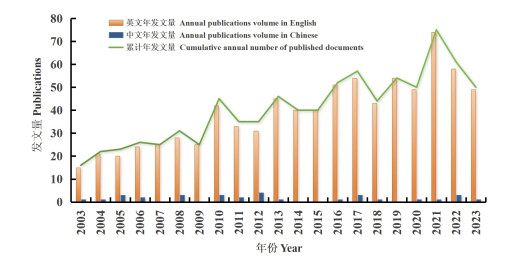 图 1 2003-2023年中英文文献年发文量及累计发文量变化趋势Fig. 1 Annual and cumulative volume of Chinese and English publications from 2003 to 2023
 下载:
全尺寸图片
下载:
全尺寸图片
2.2 发文期刊分析
中文期刊刊载量达2篇以上的期刊有7种(表 1),其中中文文献来源期刊有20个,英文文献来源期刊有233个,且前7名的英文期刊发文量显著多于中文期刊发文量。在国内外相关研究中,发表期刊主要涉及生物学领域,涵盖了昆虫学、动物学、分子生物学与遗传学等多个学科方向。
表 1 文献刊载量排名前7的中英文期刊Table 1 Top 7 Chinese and English journals by publication volume序号
Rank中文期刊
Chinese journal发文量
Publications序号
Rank英文期刊
English journal发文量
Publications1 昆虫学报Acta Entomologica Sinica 5 1 动物分类学Zootaxa 138 2 昆虫分类学报Entomotaxonomia 3 2 系统昆虫学Systematic Entomology 37 3 四川动物Sichuan Journalof Zoology 2 3 公共科学图书馆·综合PLoS ONE 36 4 基因组学与应用生物学
Genomics and Applied Biology2 4 分子系统发育与进化
Molecular Phylogenetics and Evolution33 5 广西师范大学学报(自然科学版)
Journal of Guangxi Normal University(Natural Science Edition)2 5 线粒体DNA B部分:资源Mitochondrial DNA Part B:Resources 24 6 动物学杂志Chinese Journal of Zoology 2 6 动物钥匙ZooKeys 16 7 动物分类学报Zoological Systematics 2 7 林奈学会生物学杂志
Biology Journal of the Linnean Society13 2.3 作者、所属研究机构及国家分析
作者合作网络图谱可视化分析结果显示,节点数为575,节点之间的连线为504,连线密度为0.0031(图 2)。同一研究领域内作者的合作程度能反映出该领域的研究水平和发展阶段。作者群分布呈现出“部分集中,整体分散”的特点。结果表明,国内学者内部合作较为密切,国外学者同样是内部合作较为密切,但国内、外学者间的联系较为分散。我国陕西师范大学黄原教授团队发文量最多,达41篇,法国国家自然历史博物馆(Museum National d'Histoire Naturelle,简称MNHN)的Robillard Tony教授带领的研究团队发文量最多,达43篇,属于领先水平。
 图 2 作者间的合作网络图谱注:时间范围:2003-2023(时间切片=1年);节点筛选方式:g-index(k=25),LRF=3.0,L/N=10,LBY=5,e=1.0;节点标签显示比例:1.0%;剪枝方法:Pathfinder;下同。网络参数:节点数=575,连线数=504(密度=0.0031);最大连通子图:5个,包含151个节点(占26%)。Fig. 2 Author collaboration networkNote: Timespan: 2003-2023 (Slice Length=1); Selection Criteria: g-index (k=25), LRF=3.0, L/N=10, LBY=5, e=1.0; Nodes Labeled: 1.0%; Pruning: Pathfinder; the same below. Network: N=575, E=504 (Density=0.0031); Largest: 5, CCs: 151(26%).下载:
全尺寸图片
图 2 作者间的合作网络图谱注:时间范围:2003-2023(时间切片=1年);节点筛选方式:g-index(k=25),LRF=3.0,L/N=10,LBY=5,e=1.0;节点标签显示比例:1.0%;剪枝方法:Pathfinder;下同。网络参数:节点数=575,连线数=504(密度=0.0031);最大连通子图:5个,包含151个节点(占26%)。Fig. 2 Author collaboration networkNote: Timespan: 2003-2023 (Slice Length=1); Selection Criteria: g-index (k=25), LRF=3.0, L/N=10, LBY=5, e=1.0; Nodes Labeled: 1.0%; Pruning: Pathfinder; the same below. Network: N=575, E=504 (Density=0.0031); Largest: 5, CCs: 151(26%).下载:
全尺寸图片
发文量≥20篇的研究机构共有10家(表 2),陕西师范大学Shaanxi Normal University发文量最多(87篇),其次是法国国家自然历史博物馆(MNHN)和法国国家科学研究中心(Centre National de la Recherche Scientifique,简称CNRS),分别是86篇和72篇。
表 2 研究机构贡献分析中排名前10的研究机构(发文量≥20)Table 2 Top 10 research institutions in contribution analysis (Number of articles ≥20)序号Rank 发文量Publications 研究机构Institutions 1 87 陕西师范大学Shaanxi Normal University 2 86 法国国家自然历史博物馆Museum National d'Histoire Naturelle(MNHN) 3 72 法国国家科学研究中心Centre National de la Recherche Scientifique(CNRS) 4 43 索邦大学Sorbonne Universite 5 36 河北大学Hebei University 6 30 巴黎高等研究实践学院Ecole Pratique des Hautes Etudes(EPHE) 7 29 中国科学院Chinese Academy of Sciences 8 29 巴黎文理研究大学Universite PSL 9 26 阿卡德尼兹大学Akdeniz University 10 22 华东师范大学East China Normal University 研究机构共现网络图谱可视化分析结果显示,节点数为376,节点之间的连线为460,连线密度为0.0065(图 3)。紫色节点表示介数中心性较高的研究机构,介数中心性是指在网络分析图谱中,衡量该节点在科研合作及知识传播网络中影响力的重要指标,中心性越高,表示该节点在科研合作及知识传播中越具有重要性(Ilinsky et al.,2022)。
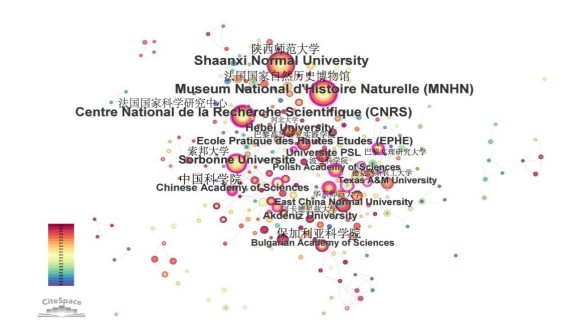 图 3 研究机构间的合作网络图谱注:网络参数:节点数=376,连线数=460(密度=0.0065);最大连通子图:10个,包含273个节点(占72%)。Fig. 3 Research institution collaboration networkNote: Network: N=376, E=460 (Density=0.0065); Largest: 10, CCs: 273 (72%).下载:
全尺寸图片
图 3 研究机构间的合作网络图谱注:网络参数:节点数=376,连线数=460(密度=0.0065);最大连通子图:10个,包含273个节点(占72%)。Fig. 3 Research institution collaboration networkNote: Network: N=376, E=460 (Density=0.0065); Largest: 10, CCs: 273 (72%).下载:
全尺寸图片
国家合作网络分析表明共有68个国家参与合作发表了直翅目昆虫DNA条形码与系统进化相关研究论文(图 4)。其中,中国主导或参与发文量最多(254篇),其次为美国(162篇)、德国(113篇)和法国(105篇)。
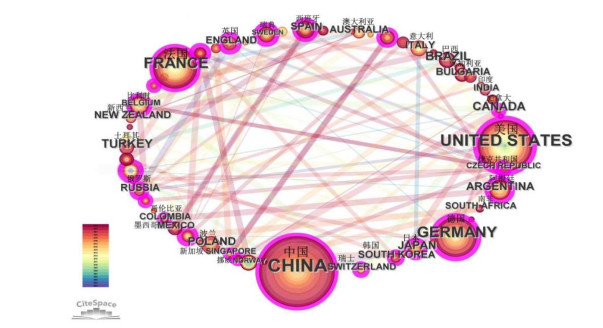 图 4 国家间的合作网络图谱注:网络参数:节点数=68,连线数=94(密度=0.0413);最大连通子图:5个,包含68个节点(占100%)。Fig. 4 Country collaboration networkNote: Network: N=68, E=94 (Density=0.0413); Largest: 5, CCs: 68 (100%).下载:
全尺寸图片
图 4 国家间的合作网络图谱注:网络参数:节点数=68,连线数=94(密度=0.0413);最大连通子图:5个,包含68个节点(占100%)。Fig. 4 Country collaboration networkNote: Network: N=68, E=94 (Density=0.0413); Largest: 5, CCs: 68 (100%).下载:
全尺寸图片
2.4 论文关键词分析
关键词是文献研究内容的精准凝练和评估研究主题的重要依据,高频关键词体现了该领域相关学者专注的前沿研究动向(张芳等,2022;张雪岩等,2024)。单纯依靠高频关键词不足以精确确定该领域的研究热点,中心度(Centrality≥0.1)是反映该领域研究热点的重要指标。CiteSpace可以对在一段时间内的某个具体领域的发展状况和趋势进行分析,从而可以发现这个学科的研究热点、前沿趋势和主题演化等方面的内容(张利江等,2024)。本研究对关键词进行了关键词共现分析,关键词聚类分析,关键词时间谱分析及关键词突现分析。
2.4.1 关键词共现分析
将检索得到的文献导入到CiteSpace软件中对其进行可视化分析,文中列出了排名前20的关键词(表 3),除动物Animal、昆虫纲Insecta、直翅目Orthoptera、属Genus、蝗亚目Caelifera、蝗虫Grasshoppers之外,出现频率高的关键词还有系统发育Phylogeny、遗传特征Genetics、分类Classification、进化Evolution、新种New species及分子系统发育Molecular phylogeny、分子进化Molecular evolution、基因组Genome、线粒体DNA Mitochondrial DNA、线粒体基因组Mitochondrial genome、核苷酸序列Nucleotide sequence等。
表 3 出现频次排名前20的关键词Table 3 Top 20 keywords by frequency of occurrence序号
Rank关键词
Keywords频次
Frequency序号
Rank关键词
Keywords频次
Frequency1 系统发育Phylogeny 355 11 分子系统发育Molecular phylogeny 79 2 进化Evolution 271 12 线粒体DNA Mitochondrial DNA 69 3 直翅目Orthoptera 268 13 线粒体基因组Mitochondrial genome 67 4 动物Animal 174 14 新种New species 64 5 昆虫纲Insecta 124 15 蝗亚目Caelifera 63 6 条目Article 122 16 核酸序列Nucleotide sequence 62 7 遗传特征Genetics 118 17 分子进化Molecular evolution 58 8 蚱蜢Grasshoppers 96 18 分类Classification 56 9 脱氧核糖核苷酸DNA 90 19 基因组Genome 55 10 其他动物的Non-human 90 20 属Genus 53 关键词共现知识图谱可视化分析结果显示,节点数为541,节点之间的连线为1 082,连线密度为0.0074(图 5)。图中的每个节点即为一个关键词,节点大小代表关键词出现的频次高低,节点间的连线表明关键词具有共现关系。
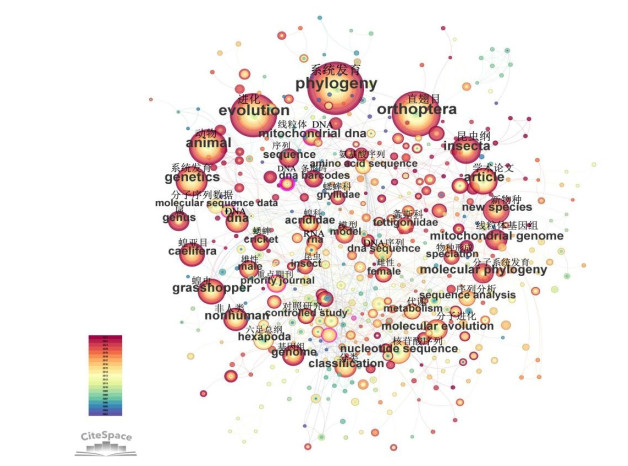 图 5 关键词共现网络图谱注:网络参数:节点数=541,连线数=1082(密度=0.0074);最大连通子图:5个,包含511个节点(占94%)。Fig. 5 Network map of keyword co-occurrenceNote: Network: N=541, E=1082 (Density=0.0074); Largest: 5, CCs: 511 (94%).下载:
全尺寸图片
图 5 关键词共现网络图谱注:网络参数:节点数=541,连线数=1082(密度=0.0074);最大连通子图:5个,包含511个节点(占94%)。Fig. 5 Network map of keyword co-occurrenceNote: Network: N=541, E=1082 (Density=0.0074); Largest: 5, CCs: 511 (94%).下载:
全尺寸图片
2.4.2 关键词聚类分析
关键词聚类分析是在共现图谱基础上,采用对数似然比LLR(Log Likelihood Ratio)检验算法进行聚类分析。聚类模块值(Modularity,简称Q值)和平均轮廓值(Silhouette,简称S值)是评价聚类效果的重要指标,通常认为,Q > 0.3表示聚类结构显著;S > 0.5表示聚类结果合理,S > 0.7聚类结果令人信服(周宏君等,2023)。通过对纳入的数据进行关键词聚类分析,聚类结果的Q值为0.7594(Q > 0.3);S值为0.9054(S > 0.7),说明聚类结果可靠。
关键词聚类知识图谱由10个聚类组成(图 6),图中显示的数字越小说明该聚类包含的关键词数量越多,#0生物地理学Biogeography表示该聚类中包含的关键词数量最多,节点规模最大,说明在使用DNA条形码进行物种分类研究时,地理、生物等因素对物种多样性的影响是该研究领域内体量最大、最受关注的核心板块。#0生物地理学Biogeography,#1声通讯Acoustic communication、#2转录组Transcriptome等共同构成了一个研究领域的主体知识结构,显示了不同规模子主题的分布。#0生物地理学Biogeography至#9 DNA条形码DNA barcoding直观展示该领域的10个主要子领域构成,以及它们的相对重要性。对其研究方向进行归纳总结,可以分为以下4个方面:#0生物地理学Biogeography主要研究生物群及其组成成分在不同地理结构下的分布特点和规律,以及物种形成、演变与环境条件的关系;#3新属New genus、#7新种New species、#6物种界定Species delimitation、#5分类Taxonomy主要是对直翅目昆虫类群在属种级别上进行物种分类及物种界定的相关研究;#1声通信Acoustic communication、#2转录组Transcriptome、#4雌性Female主要是基于物种的声音、生殖结构等特征对物种展开分类及系统发育等研究,为探讨物种的进化提供了参考依据;#8线粒体DNA Mitochondrial DNA、#9 DNA条形码DNA barcoding主要是体现了物种分类中常用的分子标记及系统发育研究过程中形成的一系列分子标记及研究方法。
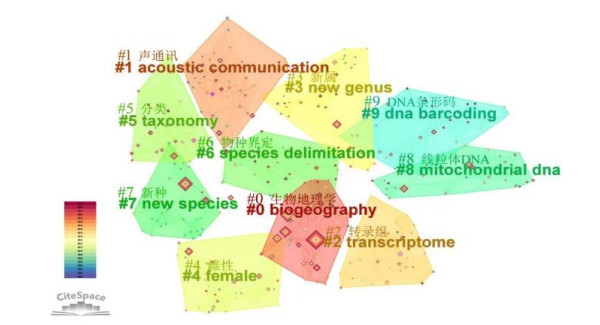 图 6 关键词聚类图谱注:网络参数:节点数=541,连线数=1082(密度=0.0074);模块化评价:模块值Q=0.7594,加权平均轮廓值S=0.9054,调和平均数(Q, S)=0.826,同下。Fig. 6 Keyword clustering mapNote: Network: N=541, E=1082 (Density=0.0074); Modularity Q=0.7594, Weighted Mean Silhouette S=0.9054, Harmonic Mean(Q, S)=0.826, the same below.下载:
全尺寸图片
图 6 关键词聚类图谱注:网络参数:节点数=541,连线数=1082(密度=0.0074);模块化评价:模块值Q=0.7594,加权平均轮廓值S=0.9054,调和平均数(Q, S)=0.826,同下。Fig. 6 Keyword clustering mapNote: Network: N=541, E=1082 (Density=0.0074); Modularity Q=0.7594, Weighted Mean Silhouette S=0.9054, Harmonic Mean(Q, S)=0.826, the same below.下载:
全尺寸图片
2.4.3 关键词时间线图谱
在关键词聚类的基础上,通过Time line View功能获得关键词时间线图(图 7)。时区视图(Timezone)以时间为主要维度,展现不同聚类之间的关键词的发展趋势及关键词之间联系的紧密程度,展现了知识演化的动态变化过程(陈悦等,2015)。系统发育Phylogeny自从2003年以来一直在直翅目的研究中占据重要地位。进化Evolution、分类Classification、新种New species、线粒体基因组Mitochondrial genome、分子进化Molecular evolution、线粒体DNA Mitochondrial DNA、DNA条形码DNA barcoding等在直翅目系统发育研究中占据重要地位,并且与其它聚类存在密切关联。在新种New species和新属New genus聚类中包含体型大小Body size、声信号Acoustic Signaling、氨基酸序列Amino acid sequence等关键词,表明物种分类常常将形态学、鸣声信息与分子标记相结合用于物种鉴定。分类Taxonomy聚类中包含基因Genes、线粒体基因Mitochondrial gene等关键词,表明在物种分类研究中分子相关的数据也占据重要地位。DNA barcoding自2011年后发展迅速,5S rRNA、12S rRNA、16S rRNA、Mitochondrial DNA等常见分子标记的发展也促进了DNA条形码在直翅目昆虫系统发育研究中的运用。
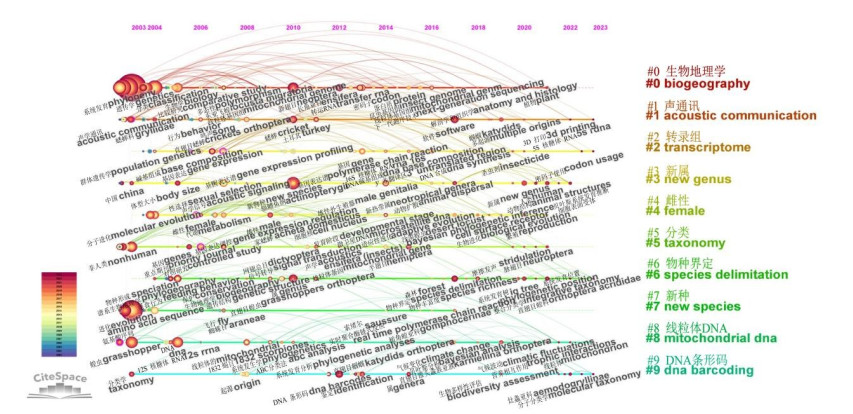 图 7 关键词聚类时间线图注:网络参数:节点数=541,连线数=1082(密度=0.0074);模块化评价:模块值Q=0.7594,加权平均轮廓值S=0.9054,调和平均数(Q, S) =0.826。Fig. 7 Timeline visualization of keyword clustersNote: Network: N=541, E=1082 (Density=0.0074); Modularity Q=0.7594, Weighted Mean Silhouette S= 0.9054, Harmonic Mean(Q, S)=0.826.下载:
全尺寸图片
图 7 关键词聚类时间线图注:网络参数:节点数=541,连线数=1082(密度=0.0074);模块化评价:模块值Q=0.7594,加权平均轮廓值S=0.9054,调和平均数(Q, S) =0.826。Fig. 7 Timeline visualization of keyword clustersNote: Network: N=541, E=1082 (Density=0.0074); Modularity Q=0.7594, Weighted Mean Silhouette S= 0.9054, Harmonic Mean(Q, S)=0.826.下载:
全尺寸图片
2.4.4 关键词突现分析
突现关键词是指频率快速增加的关键词。分析其突现性是突出一段时期内学术界特别关注的研究方向的一种分析方式,主要为分析研究前沿,在发现研究热点等方面具有重要的价值。关键词突现图谱可以展示词频激增现象,这些关键词常被认为代表着该领域研究热点的变迁(陈悦等,2015)。突现性分析中随着γ参数设置的不同,获取的关键词数目也会随之改变。该研究设定γ值为1,最小时间间隔为1年。关键词突现图谱的文献跨度为2003-2023年(表 4)。对前20个关键词进行分析,早期的关键词为六足亚门Hexapoda、蝗亚目Caelifera、蝗科Acrididae突现词集中在直翅目昆虫科及以上的分类层次研究上。在2018年以后新种New species、属Genus、新属New Genus等突现词,表明分类研究开始深入到属、种及种下分类单元的系统发育关系研究中。序列Sequence、分子序列数据Molecular sequence data、分子遗传学Molecular genetics、线粒体基因组Mitochondrial genome、DNA碱基组成DNA base composition、线粒体全基因组Complete mitochondrial genome等关键词的突现表明直翅目昆虫系统发育的分子标记趋于多样化,推动了DNA条形码在直翅目分类研究中的快速发展。遗传多样性Genetic variability、物种界定Species delimitation、昆虫蛋白Insect protein、DNA条形码DNA barcodes、自然选择Selection、软件Software等关键词的突现表明在利用DNA条形码作为物种分类分子标记的研究中,除了分子标记的多样化,也衍生出了一系列的技术手段,能够更加清晰的观察到物种内部、物种与物种之间的遗传变异,为物种界定提供更加有利的证据。
表 4 突现性前20的关键词(γ=1,n=20)Table 4 Top 20 Keywords with the Strongest Citation Bursts(γ=1, n=20)关键词Keywords 时间Year 强度Strength 起始Begin 结束End 遗传多样性Genetic variability 2005 4.69 2005 2013 六足亚门Hexapoda 2003 8.94 2006 2013 分子序列数据Molecular sequence data 2006 7.37 2006 2015 分子遗传学Molecular genetics 2006 5.68 2010 2015 蝗科Acrididae 2003 4.49 2011 2013 昆虫蛋白质Insect protein 2007 4.99 2012 2018 蝗亚目Caelifera 2005 6.15 2015 2020 DNA条形码DNA barcodes 2012 4.70 2015 2023 线粒体基因组多样性Mitochondrial genome diversily 2010 7.37 2016 2023 多样性Diversity 2016 6.00 2016 2023 DNA碱基组成DNA base composition 2016 4.47 2016 2017 物种界定Species delimitation 2017 6.29 2017 2023 新物种New species 2010 5.14 2018 2021 自然选择Selection 2013 4.69 2018 2023 中国China 2003 4.20 2018 2023 线粒体全基因组Complete mitochondrial genome 2016 6.44 2019 2023 序列Sequence 2003 5.59 2019 2023 软件Software 2017 5.49 2020 2023 新属New genus 2020 4.49 2020 2021 属Genus 2010 5.80 2021 2023 3. 结论与讨论
本文利用CiteSpace对2003-2023年收录在中国知网、WoSCC、Scopus和PubMed数据库中,与直翅目昆虫DNA条形码及分子系统进化研究相关的849篇文献从发文时间分布、关键作者、研究热点与研究路径演变、研究前沿等方面进行可视化分析。总体来看,从2003-2023年该领域的研究呈现上升趋势。
自2003年DNA条形码的概念被提出,印红等(2003)使用16S rRNA对蝗总科8科8种进行分子进化分析,确定了该蝗总科8科的起源关系。在此基础上,Zhang等(2005)基于线粒体16S rRNA部分序列对中国癞蝗科Pamphagidae的9个物种进行分子系统分析,解释了该9个种的亲缘关系。利用DNA条形码序列实现了对物种科级到种级分类单元的确定。为提高DNA条形码物种鉴定的准确性,基于线粒体16S rRNA和COI基因序列,并结合系统地理模式,Allegrucci等(2005)阐明了地中海洞穴蟋蟀的系统发育和生物地理关系。此后,18S rRNA(Terry and Whiting, 2005)、12S rRNA和ND5(叶维萍等,2005)、ND2(丁方美和黄原,2008)、COI、COⅡ、ITS1、ITS2(Trewick et al.,2005)、Cyt b(王乃馨等,2008)等单基因片段,多基因片段联合的鉴定方式陆续被用于直翅目昆虫的物种鉴定及系统发育研究中,并延续至今(Timm et al.,2022;Zhu et al.,2025)。线粒体基因组作为DNA条形码,相对于COI等单基因序列及其他短片段序列,其蕴含的DNA信息丰富,能够克服单基因或少数基因片段面临的局限性。在Flook等(1995)完成非洲飞蝗Locusta migratoria migratoioides线粒体基因组测定后,目前GenBank数据库中,共收录504条直翅目昆虫线粒体基因组序列,线粒体基因组被测定并用于直翅目昆虫系统进化研究中(Song et al.,2015;Zhou et al.,2017;Ruiz-Mendoza et al.,2023;Liu et al.,2025)。
DNA条形码技术是指利用一段或几段生物体自身DNA片段实现快速、准确和自动化的物种鉴定的新兴技术。线粒体COI基因特定片段作为DNA条形码标准区段不仅被大量用于直翅目昆虫物种鉴定研究(Guo et al.,2016;Zhao et al.,2016;Hawlitschek et al.,2017;Zhou et al.,2019),同时也帮助生物学家进一步了解生态系统内发生的相互作用。现阶段依旧存在着一些问题和挑战。线粒体基因是常用的DNA条形码,在利用COI基因作为DNA条形码对物种进行鉴定时,常常受到核线粒体假基因(numts)限制,因此鉴定结果的准确性常常会受到影响(Moulton et al.,2010)。许多生物存在不完全支系演化与杂交等基因渗入现象也为DNA条形码作为物种鉴定工具增加了一定的难度(程希婷等,2011)。此外,仅仅利用DNA条形码进行系统发育的研究,常常会因为未涉及到自然史和形态学的证据,将物种形成相关的潜在进化过程掩盖。因此将昆虫石化数据、形态学特征联合多基因数据运用在直翅目昆虫的系统发育研究中必不可少。另一方面,NCBI数据库收录的物种DNA条形码数据并不均衡,大多数的昆虫物种都缺乏可供参考DNA条形码序列,这也是DNA条形码在使用中存在的局限性(Virgilio et al.,2010)。
综上所述,不断增加物种的基因序列数据以扩充DNA条形码数据库,有利于提高DNA条形码物种鉴定的准确性。从基于COI的单基因条形码,到多基因片段联合分析,乃至线粒体基因组的应用,在方法学上为物种分类、界定和系统发育重建提供了日益强大的工具。随着测序技术的发展,利用全基因组尺度的分子标记,并结合地理分布与气候环境数据进行多维数据整合,将为阐明昆虫的系统发育及演化历史提供全新视角。
-
图 1 2003-2023年中英文文献年发文量及累计发文量变化趋势
Fig. 1 Annual and cumulative volume of Chinese and English publications from 2003 to 2023
下载:
全尺寸图片
图 2 作者间的合作网络图谱
注:时间范围:2003-2023(时间切片=1年);节点筛选方式:g-index(k=25),LRF=3.0,L/N=10,LBY=5,e=1.0;节点标签显示比例:1.0%;剪枝方法:Pathfinder;下同。网络参数:节点数=575,连线数=504(密度=0.0031);最大连通子图:5个,包含151个节点(占26%)。
Fig. 2 Author collaboration network
Note: Timespan: 2003-2023 (Slice Length=1); Selection Criteria: g-index (k=25), LRF=3.0, L/N=10, LBY=5, e=1.0; Nodes Labeled: 1.0%; Pruning: Pathfinder; the same below. Network: N=575, E=504 (Density=0.0031); Largest: 5, CCs: 151(26%).
下载:
全尺寸图片
图 3 研究机构间的合作网络图谱
注:网络参数:节点数=376,连线数=460(密度=0.0065);最大连通子图:10个,包含273个节点(占72%)。
Fig. 3 Research institution collaboration network
Note: Network: N=376, E=460 (Density=0.0065); Largest: 10, CCs: 273 (72%).
下载:
全尺寸图片
图 4 国家间的合作网络图谱
注:网络参数:节点数=68,连线数=94(密度=0.0413);最大连通子图:5个,包含68个节点(占100%)。
Fig. 4 Country collaboration network
Note: Network: N=68, E=94 (Density=0.0413); Largest: 5, CCs: 68 (100%).
下载:
全尺寸图片
图 5 关键词共现网络图谱
注:网络参数:节点数=541,连线数=1082(密度=0.0074);最大连通子图:5个,包含511个节点(占94%)。
Fig. 5 Network map of keyword co-occurrence
Note: Network: N=541, E=1082 (Density=0.0074); Largest: 5, CCs: 511 (94%).
下载:
全尺寸图片
图 6 关键词聚类图谱
注:网络参数:节点数=541,连线数=1082(密度=0.0074);模块化评价:模块值Q=0.7594,加权平均轮廓值S=0.9054,调和平均数(Q, S)=0.826,同下。
Fig. 6 Keyword clustering map
Note: Network: N=541, E=1082 (Density=0.0074); Modularity Q=0.7594, Weighted Mean Silhouette S=0.9054, Harmonic Mean(Q, S)=0.826, the same below.
下载:
全尺寸图片
图 7 关键词聚类时间线图
注:网络参数:节点数=541,连线数=1082(密度=0.0074);模块化评价:模块值Q=0.7594,加权平均轮廓值S=0.9054,调和平均数(Q, S) =0.826。
Fig. 7 Timeline visualization of keyword clusters
Note: Network: N=541, E=1082 (Density=0.0074); Modularity Q=0.7594, Weighted Mean Silhouette S= 0.9054, Harmonic Mean(Q, S)=0.826.
下载:
全尺寸图片
表 1 文献刊载量排名前7的中英文期刊
Table 1 Top 7 Chinese and English journals by publication volume
序号
Rank中文期刊
Chinese journal发文量
Publications序号
Rank英文期刊
English journal发文量
Publications1 昆虫学报Acta Entomologica Sinica 5 1 动物分类学Zootaxa 138 2 昆虫分类学报Entomotaxonomia 3 2 系统昆虫学Systematic Entomology 37 3 四川动物Sichuan Journalof Zoology 2 3 公共科学图书馆·综合PLoS ONE 36 4 基因组学与应用生物学
Genomics and Applied Biology2 4 分子系统发育与进化
Molecular Phylogenetics and Evolution33 5 广西师范大学学报(自然科学版)
Journal of Guangxi Normal University(Natural Science Edition)2 5 线粒体DNA B部分:资源Mitochondrial DNA Part B:Resources 24 6 动物学杂志Chinese Journal of Zoology 2 6 动物钥匙ZooKeys 16 7 动物分类学报Zoological Systematics 2 7 林奈学会生物学杂志
Biology Journal of the Linnean Society13 表 2 研究机构贡献分析中排名前10的研究机构(发文量≥20)
Table 2 Top 10 research institutions in contribution analysis (Number of articles ≥20)
序号Rank 发文量Publications 研究机构Institutions 1 87 陕西师范大学Shaanxi Normal University 2 86 法国国家自然历史博物馆Museum National d'Histoire Naturelle(MNHN) 3 72 法国国家科学研究中心Centre National de la Recherche Scientifique(CNRS) 4 43 索邦大学Sorbonne Universite 5 36 河北大学Hebei University 6 30 巴黎高等研究实践学院Ecole Pratique des Hautes Etudes(EPHE) 7 29 中国科学院Chinese Academy of Sciences 8 29 巴黎文理研究大学Universite PSL 9 26 阿卡德尼兹大学Akdeniz University 10 22 华东师范大学East China Normal University 表 3 出现频次排名前20的关键词
Table 3 Top 20 keywords by frequency of occurrence
序号
Rank关键词
Keywords频次
Frequency序号
Rank关键词
Keywords频次
Frequency1 系统发育Phylogeny 355 11 分子系统发育Molecular phylogeny 79 2 进化Evolution 271 12 线粒体DNA Mitochondrial DNA 69 3 直翅目Orthoptera 268 13 线粒体基因组Mitochondrial genome 67 4 动物Animal 174 14 新种New species 64 5 昆虫纲Insecta 124 15 蝗亚目Caelifera 63 6 条目Article 122 16 核酸序列Nucleotide sequence 62 7 遗传特征Genetics 118 17 分子进化Molecular evolution 58 8 蚱蜢Grasshoppers 96 18 分类Classification 56 9 脱氧核糖核苷酸DNA 90 19 基因组Genome 55 10 其他动物的Non-human 90 20 属Genus 53 表 4 突现性前20的关键词(γ=1,n=20)
Table 4 Top 20 Keywords with the Strongest Citation Bursts(γ=1, n=20)
关键词Keywords 时间Year 强度Strength 起始Begin 结束End 遗传多样性Genetic variability 2005 4.69 2005 2013 六足亚门Hexapoda 2003 8.94 2006 2013 分子序列数据Molecular sequence data 2006 7.37 2006 2015 分子遗传学Molecular genetics 2006 5.68 2010 2015 蝗科Acrididae 2003 4.49 2011 2013 昆虫蛋白质Insect protein 2007 4.99 2012 2018 蝗亚目Caelifera 2005 6.15 2015 2020 DNA条形码DNA barcodes 2012 4.70 2015 2023 线粒体基因组多样性Mitochondrial genome diversily 2010 7.37 2016 2023 多样性Diversity 2016 6.00 2016 2023 DNA碱基组成DNA base composition 2016 4.47 2016 2017 物种界定Species delimitation 2017 6.29 2017 2023 新物种New species 2010 5.14 2018 2021 自然选择Selection 2013 4.69 2018 2023 中国China 2003 4.20 2018 2023 线粒体全基因组Complete mitochondrial genome 2016 6.44 2019 2023 序列Sequence 2003 5.59 2019 2023 软件Software 2017 5.49 2020 2023 新属New genus 2020 4.49 2020 2021 属Genus 2010 5.80 2021 2023 -
Allegrucci G, Todisco V, Sbordoni V. Molecular phylogeography of Dolichopoda cave crickets (Orthoptera, Rhaphidophoridae): a scenario suggested by mitochondrial DNA [J]. Molecular Phylogenetics and Evolution, 2005, 37 (1): 153-164. doi: 10.1016/j.ympev.2005.04.022 Almuteri JS, Al Wahaibi MS, Mustafa AEM, et al. Morphological characterization and DNA barcoding of Ruellia sp. in Saudi Arabia [J]. PLoS ONE, 2025, 20 (2): e0315827. doi: 10.1371/journal.pone.0315827 Amorim IC, Melo ADS, Silva AFD, et al. Characterization of the mitogenome of Rhammatocerus brasiliensis and phylogenetic analysis of the family Acrididae (Orthoptera) [J]. Gene, 2020, 731: 144362. doi: 10.1016/j.gene.2020.144362 Chen C. Science mapping: a systematic review of the literature [J]. Journal of Data and Information Science, 2017, 2 (2): 1-40. Chen C. Searching for intellectual turning points: progressive knowledge domain visualization [J]. Proc. Natl. Acad. Sci. USA, 2004, 101 (Suppl. 1): 5303-5310. 陈悦, 陈超美, 刘则渊, 等. CiteSpace知识图谱的方法论功能[J]. 科学学研究, 2015, 33 (2): 242-253 Chen Y, Chen CM, Liu ZY, et al. The methodology function of CiteSpace mapping knowledge domains [J]. Studies in Science of Science, 2015, 33 (2): 242-253. 程希婷, 王爱民, 顾志峰, 等. DNA条形码研究进展[J]. 基因组学与应用生物学, 2011, 30 (6): 748-758 Cheng XT, Wang AM, Gu ZF, et al. Current progress of DNA barcoding [J]. Current Progress of DNA Barcoding, 2011, 30 (6): 748-758. Chimeno C, Morinière J, Podhorna J, et al. DNA barcoding in forensic entomology-establishing a DNA reference library of potentially forensic relevant arthropod species Response [J]. Journal of Forensic Sciences, 2019, 64 (4): 1287-1287. doi: 10.1111/1556-4029.14095 Cigliano MM, Braun H, Eades DC, et al. Orthoptera Species File. 2025. http://orthoptera.speciesfile.org/. Dan ZC, Guan DL, Jiang T, et al. Evolution of gene arrangements in the mitogenomes of Ensifera and characterization of the complete mitogenome of Schizodactylus jimo [J]. International Journal of Molecular Sciences, 2022, 23 (20): 12094. doi: 10.3390/ijms232012094 丁方美, 黄原. 基于线粒体ND2基因的中国斑翅蝗科部分种类分子系统学研究(直翅目: 蝗总科) [J]. 昆虫学报, 2008, 1: 55-60 Ding FM, Huang Y. Molecular evolution and phylogenetic analysis of some species of Oedipodidae (Orthoptera: Caelifera) in China based on complete mitochondrial ND2 gene [J]. Acta Entomologica Sinica, 2008, 1: 55-60. Flook PK, Rowell CH, Gellissen G. The sequence, organization, and evolution of the Locusta migratoria mitochondrial genome [J]. J. Mol. Evol., 1995, 41 (6): 928-941. Garfield E. From the science of science to Scientometrics visualizing the history of science with HistCite software [J]. Journal of Informetrics, 2009, 3 (3): 173-179. doi: 10.1016/j.joi.2009.03.009 Gu J, Jiang B, Wang H, et al. Phylogeny and species delimitation of the genus Longgenacris and Fruhstorferiola viridifemorata species group (Orthoptera: Acrididae: Melanoplinae) based on molecular evidence [J]. PLoS ONE, 2020, 15 (8): e0237882. doi: 10.1371/journal.pone.0237882 Guan DL, Huang CM, Deng WA. Reassessment of the phylogenetics of two pygmy grasshopper generic groups Tetrix and Systolederus through mitochondrial phylogenomics using four new mitochondrial genome assemblies [J]. Insects, 2024, 15 (3): 174. doi: 10.3390/insects15030174 Guerrero MS, Cayabyab BF. DNA Barcoding of Locusta migratoria manilensis (Orthoptera: Acrididae) reveals insights into the species and subspecies differentiation [J]. Journal of Entomological Science, 2024, 59 (2): 125-132. Guo HF, Guan B, Shi FM, et al. DNA Barcoding of genus Hexacentrus in China reveals cryptic diversity within Hexacentrus japonicus (Orthoptera, Tettigoniidae) [J]. Zookeys, 2016, 596: 53-63. doi: 10.3897/zookeys.596.8669 Guo YJ, An SQ, Fang ZG, et al. A taxonomic revision of the genus Goniogryllus in China (Orthoptera: Gryllidae: Gryllinae) [J]. Arthropod Systematics & Phylogeny, 2024, 82: 567-584. Hawlitschek O, Morinière J, Lehmann GUC, et al. DNA barcoding of crickets, katydids and grasshoppers (Orthoptera) from Central Europe with focus on Austria, Germany and Switzerland [J]. Molecular Ecology Resources, 2017, 17 (5): 1037-1053. doi: 10.1111/1755-0998.12638 He ZQ, Shen CZ, Wu X. The first phylogenetic study of sword-tail crickets from China inferred from COI, 18S and 28S genes, with the estilish Entnt of two new genera and description of one new species (Orthoptera: Grytioidea: Trigonidiinae) [J]. Zootaxa, 2020, 4890 (1): 119-128. Hebert PD, Cywinska A, Ball SL, et al. Biological identifications through DNA barcodes [J]. Proc. Biol. Sci., 2003, 270 (1512): 313-321. doi: 10.1098/rspb.2002.2218 Heo GE, Kang KY, Song M, et al. Analyzing the field of bioinformatics with the multi-faceted topic modeling technique [J]. BMC Bioinformatics, 2017, 18 (Suppl. 7): 251. Ilinsky Y, Demenkova M, Bykov R, et al. Narrow Genetic Diversity of Wolbachia Symbionts in Acrididae Grasshopper Hosts (Insecta, Orthoptera) [J]. International Journal of Molecular Sciences, 2022, 23 (2): 853. doi: 10.3390/ijms23020853 Kang TH, Kim S, Hong KJ, et al. DNA barcoding in quarantine inspection: a case study on quarantine insect monitoring for Lepidoptera obtained through quarantine inspection on foreign vessels [J]. Mitochondrial DNA B Resources, 2019, 4 (1): 43-48. doi: 10.1080/23802359.2018.1536447 Leavitt JR, Hiatt KD, Whiting MF, et al. Searching for the optimal data partitioning strategy in mitochondrial phylogenomics: a phylogeny of Acridoidea (Insecta: Orthoptera: Caelifera) as a case study [J]. Molecular Phylogenetics and Evolution, 2013, 67 (2): 494-508. doi: 10.1016/j.ympev.2013.02.019 Liu X, Fu Y, Li X, et al. Description and phylogenetic studies on the complete mitochondrial genome of Kingdonella qinghaiensis Zheng (Insecta: Orthoptera: Acrididae) [J]. Zootaxa, 2025, 5601 (3): 476-490. doi: 10.11646/zootaxa.5601.3.4 Moulton MJ, Song HJ, Whiting MF. Assessing the effects of primer specificity on eliminating numt coamplification in DNA barcoding: a case study from Orthoptera (Arthropoda: Insecta) [J]. Molecular Ecology Resources, 2010, 10 (4): 615-627. doi: 10.1111/j.1755-0998.2009.02823.x Ren J, Ren L, Zhang R. Delimiting species, revealing cryptic diversity, and population divergence in Qinghai-Tibet Plateau weevils through DNA barcoding [J]. Ecology and Evolution, 2024, 14 (7): e11592. doi: 10.1002/ece3.11592 Ruiz-Mendoza PX, Jasso-Martínez JM, Gutiérrez-Rodríguez J, et al. Mitochondrial genome characterization and mitogenome phylogenetics in the central Mexican Stenopelmatus talpa complex (Orthoptera: Stenopelmatidae: Stenopelmatini) [J]. Revista Mexicana De Biodiversidad, 2023, 94: e945094. doi: 10.22201/ib.20078706e.2023.94.5094 Salis R, Sunde J, Gubonin N, et al. Performance of DNA metabarcoding, standard barcoding and morphological approaches in the identification of insect biodiversity [J]. Mol. Ecol. Resour., 2024, 24 (8): e14018. doi: 10.1111/1755-0998.14018 Song HJ, Amedegnato C, Cigliano MM, et al. 300 million years of diversification: elucidating the patterns of orthopteran evolution based on comprehensive taxon and gene sampling [J]. Cladistics, 2015, 31 (6): 621-651. doi: 10.1111/cla.12116 Terry MD, Whiting MF. Mantophasmatodea and phylogeny of the lower neopterous insects [J]. Cladistics, 2005, 21 (3): 240-257. doi: 10.1111/j.1096-0031.2005.00062.x Timm VF, Gonçalves LT, Valente VLDS, et al. The efficiency of the COI gene as a DNA barcode and an overview of Orthoptera (Caelifera and Ensifera) sequences in the BOLD System [J]. Canadian Journal of Zoology, 2022, 100 (11): 710-718. doi: 10.1139/cjz-2022-0041 Trewick SA, Goldberg J, Morgan-Richards M. Fewer species of Argosarchus and Clitarchus stick insects (Phasmida, Phasmatinae): evidence from nuclear and mitochondrial DNA sequence data [J]. Zoologica Scripta, 2005, 34 (5): 483-491. doi: 10.1111/j.1463-6409.2005.00204.x Van Eck NJ, Waltman L. Software survey: VOSviewer, a computer program for bibliometric mapping [J]. Scientometrics, 2010, 84 (2): 523-538. doi: 10.1007/s11192-009-0146-3 Virgilio M, Backeljau T, Nevado B, et al. Comparative performances of DNA barcoding across insect orders [J]. BMC Bioinformatics, 2010, 11: 206. doi: 10.1186/1471-2105-11-206 Wang H, Jiang B, Gu J, et al. Molecular phylogeny and species delimitation of the genus Tonkinacris (Orthoptera, Acrididae, Melanoplinae) from China [J]. PLoS ONE, 2021, 16 (4): e0249431. doi: 10.1371/journal.pone.0249431 王乃馨, 封霞, 蒋国芳, 等. 基于线粒体基因Cytb和COI的蝗科中五亚科分子系统发育关系分析(直翅目: 蝗总科) (英文) [J]. 昆虫学报, 2008, 51 (11): 1187-1195 Wang NX, Feng X, Jiang GF, et al. Molecular phylogenetic analysis of five subfamilies of the Acrididae (Orthoptera: Acridoidea) based on the mitochondrial cytochrome b and cytochrome c oxidase subunit I gene sequences [J]. Acta Entomologica Sinica, 2008, 51 (11): 1187-1195. 叶维萍, 叶海燕, 卢慧甍, 等. 基于线粒体12S rRNA和ND5基因序列的中国飞蝗属3亚种系统发育关系研究[J]. 昆虫分类学报, 2005, 27 (1): 5-13 Ye WP, Ye HY, Lu HM, et al. The phylogenetic relationship among three subspecies of the genus Locusta L. in China based on partial sequences of 12S rRNA and ND5 Gene [J]. Entomotaxonomia, 2005, 27 (1): 5-13. 印红, 张道川, 毕智丽, 等. 蝗总科部分种类16S rDNA的分子系统发育关系[J]. 遗传学报, 2003, 30 (8): 766-772 Yin H, Zhang DC, Bi ZL, et al. Molecular phylogeny of some species of the Acridoidea based on 16S rDNA [J]. Acta Genetica Sinica, 2003, 30 (8): 766-72. Zahid S, Mariño-Pérez R, Song H. Molecular phylogeny of the grasshopper family Pyrgomorphidae (Caelifera, Orthoptera) reveals rampant paraphyly and convergence of traditionally used taxonomic characters [J]. Zootaxa, 2021, 4969 (1): 101-118. Zhang CL, Mao BY, Wang HQ, et al. The complete mitogenomes of three grasshopper species with special notes on the phylogenetic positions of some related genera [J]. Insects, 2023, 14 (1): 85. doi: 10.3390/insects14010085 Zhang D, Li XJ, Wang WQ, et al. Molecular phylogeny of some genera of Pamphagidae (Acridoidea, Orthoptera) from China based on mitochondrial 16S rDNA sequences [J]. Zootaxa, 2005, 1103: 41-49. 张芳, 吴昌键, 张霞, 等. 基于Web of Science文献计量分析的宁夏枸杞研究现状和发展态势[J]. 中草药, 2022, 53 (16): 5128-5141 Zhang F, Wu CJ, Zhang X. Research status and development trend of Lycium barbarum based on bibliometric analysis of Web of Science [J]. Chinese Traditional and Herbal Drugs, 2022, 53 (16): 5128-5141. 张利江, 刘文璐, 任文杰. 基于CiteSpace的国内在线医疗用户择医行为研究[J]. 中国医院, 2024, 28 (9): 28-31 Zhang LJ, Liu WL, Ren WJ. Research on online medical users' physician selection behavior in China based on CiteSpace [J]. Chinese Hospitals, 2024, 28 (9): 28-31. 张雪岩, 李娜, 张国琴, 等. 基于CiteSpace知识图谱的中药旋覆花研究现状的可视化分析[J]. 中国现代应用药学, 2024, 41 (15): 2136-2146 Zhang X, Li N, Zhang G et al. Visual analysis of the research status of traditional Chinese medicine Inula japonica based on CiteSpace knowledge map [J]. Chinese Journal of Modern Applied Pharmacy, 2024, 41 (15): 2136-2146. Zhao L, Lin LL, Zheng ZM. DNA barcoding reveals polymorphism in the pygmy grasshopper Tetrix bolivari (Orthoptera, Tetrigidae) [J]. Zookeys, 2016, 582: 111-120. doi: 10.3897/zookeys.582.6301 Zhao Y, Wang H, Huang H, et al. A DNA barcode library for katydids, cave crickets, and leaf-rolling crickets (Tettigoniidae, Rhaphidophoridae and Gryllacrididae) from Zhejiang Province, China [J]. Zookeys, 2022, 1123: 147-171. doi: 10.3897/zookeys.1123.86704 周宏君, 张鲁, 曾进浩, 等. 基于CiteSpace知识图谱的远志研究热点与前沿分析[J]. 中国中药杂志, 2023, 48 (6): 1664-1672 Zhou HJ, Zhang L, Zeng JH, et al. CiteSpace knowledge map of research hotspots and frontiers of polygalae radix [J]. China Journal of Chinese Materia Medica, 2023, 48 (6): 1664-1672. Zhou ZJ, Guo HF, Han L, et al. Singleton molecular species delimitation based on COI-5P barcode sequences revealed high cryptic/undescribed diversity for Chinese katydids (Orthoptera: Tettigoniidae) [J]. Bmc Evolutionary Biology, 2019, 19 (1): 79. doi: 10.1186/s12862-019-1404-5 Zhou ZJ, Zhao L, Liu N, et al. Towards a higher-level Ensifera phylogeny inferred from mitogenome sequences [J]. Molecular Phylogenetics and Evolution, 2017, 108: 22-33. doi: 10.1016/j.ympev.2017.01.014 Zhu QD, Wang HJ, Zhou ZJ, et al. Phylogeny and integrative taxonomy of the genera Gymnaetoides and Pseudotachycines (Orthoptera: Rhaphidophoridae) [J]. Insects, 2022, 13 (7): 628. doi: 10.3390/insects13070628 Zhu YN, Hu TH, He ZQ. A preliminary phylogenetic study of the cricket subfamily Phaloriinae (Orthoptera: Phalangopsidae: Phaloriinae) [J]. Zootaxa, 2025, 5583 (3): 560-566. doi: 10.11646/zootaxa.5583.3.8
